How Many Gifts Should Kids Get for Christmas? The Four-Gift Rule Explained
Drowning in toy catalogs and wish lists? The four-gift rule — want, need, wear, read — is the simplest framework for a more intentional Christmas. Here's how it works, and how to make every slot count.
Every November, the same feeling creeps in: you open the toy catalog your kid has been dog-earing for weeks, and suddenly Christmas morning looks like a clearance aisle. You want the holidays to feel magical — not excessive. You want your child's eyes to light up — not to glaze over from sheer volume. If you've been quietly wondering whether there's a better way to do gifts, you're not alone. Parents across the country are rethinking the pile-it-high approach, and for good reason.
Quick answer: Most child development experts agree that fewer, more intentional gifts create more gratitude and joy than a large pile of presents. The four-gift rule — one thing they want, one thing they need, one thing to wear, one thing to read — is the most widely used framework for scaling back without scaling down the magic. Four gifts is enough.
The good news is that "intentional" doesn't mean joyless. It means choosing gifts that actually mean something — gifts your child will remember past January. Below, we'll break down where the four-gift rule came from, what each category really means, and how to make every one of those four slots count.

Where the Four-Gift Rule Comes From
The four-gift rule didn't come from a pediatrician's office or a parenting book — it emerged organically from parents sharing ideas online, particularly on platforms like Pinterest and parenting forums in the early 2010s. The premise was simple: instead of an arbitrary pile of gifts, give each child exactly four — one in each of four categories. The idea spread quickly because it resonated. It gave parents permission to say "enough" without feeling like the Grinch.
While the four-gift rule is the most popular minimalist gifting framework, it has some close cousins. The five-gift rule adds a fifth category — something to do, like an experience or activity — and the seven-gift rule expands further with items like a game, a stocking stuffer category, and something charitable. The 20 toy rule, popularized in a different context, suggests limiting kids' total toy collection to 20 items to encourage deeper engagement with each one. None of these is "right" — but they all share the same core belief: less stuff, more meaning.
What makes the four-gift rule stick is its simplicity. Each category has a clear purpose, and together they cover the full landscape of what a child actually needs at Christmas — without tipping into excess. It also takes the mental load off parents who spend weeks agonizing over how many presents is too many. Four is the answer. Write it on a sticky note.
Want, Need, Wear, Read: What Each Category Actually Means
The beauty of the four-gift rule is that it's a framework, not a checklist. Each slot has a role to play, and when you think them through carefully, they add up to a genuinely well-rounded Christmas morning.
- Something they WANT — the one thing from the wish list that they've been talking about for months. This is the star of Christmas morning. It doesn't need to be expensive; it needs to be chosen.
- Something they NEED — practical, but chosen with care. New art supplies for the kid who fills every notebook. A puzzle that matches their current developmental stage. Needs don't have to feel like chores in gift wrap.
- Something to WEAR — clothing that reflects who they are, not just what fits. A cozy sweater in their favorite color. A costume for their favorite character. Clothes they'll actually want to put on.
- Something to READ — a book, or something that sparks a love of stories. This is the slot most parents underestimate — and the one with the most potential to last.
The "want" and "wear" categories are usually easy. "Need" takes a little creativity to make feel festive. But "read" is where most parents reach for a generic board book or the latest bestseller and call it done. That's understandable — but it's also a missed opportunity. Because when you consider that this is a gift meant to be returned to again and again, over months and years, the "read" slot deserves more thought than any other.
Parents who are committed to intentional gifting — who've already decided that four gifts is enough — are exactly the kind of people who will notice the difference between a book that gets read once and forgotten, and a book that becomes part of a child's sense of self. If you're already thinking this carefully about what goes under the tree, think just as carefully about what goes in the "read" slot.
Making the 'Read' Gift Count
Here's the thing about the "read" gift: it's the only one of the four that can genuinely become a keepsake. Toys break or get outgrown. Clothes are sized out of within a season. But the right book — one that a child connects with deeply — can travel from the bookshelf to the bedtime routine to a memory they carry into adulthood. The question is what makes a book that kind of gift, rather than just another item checked off a list.
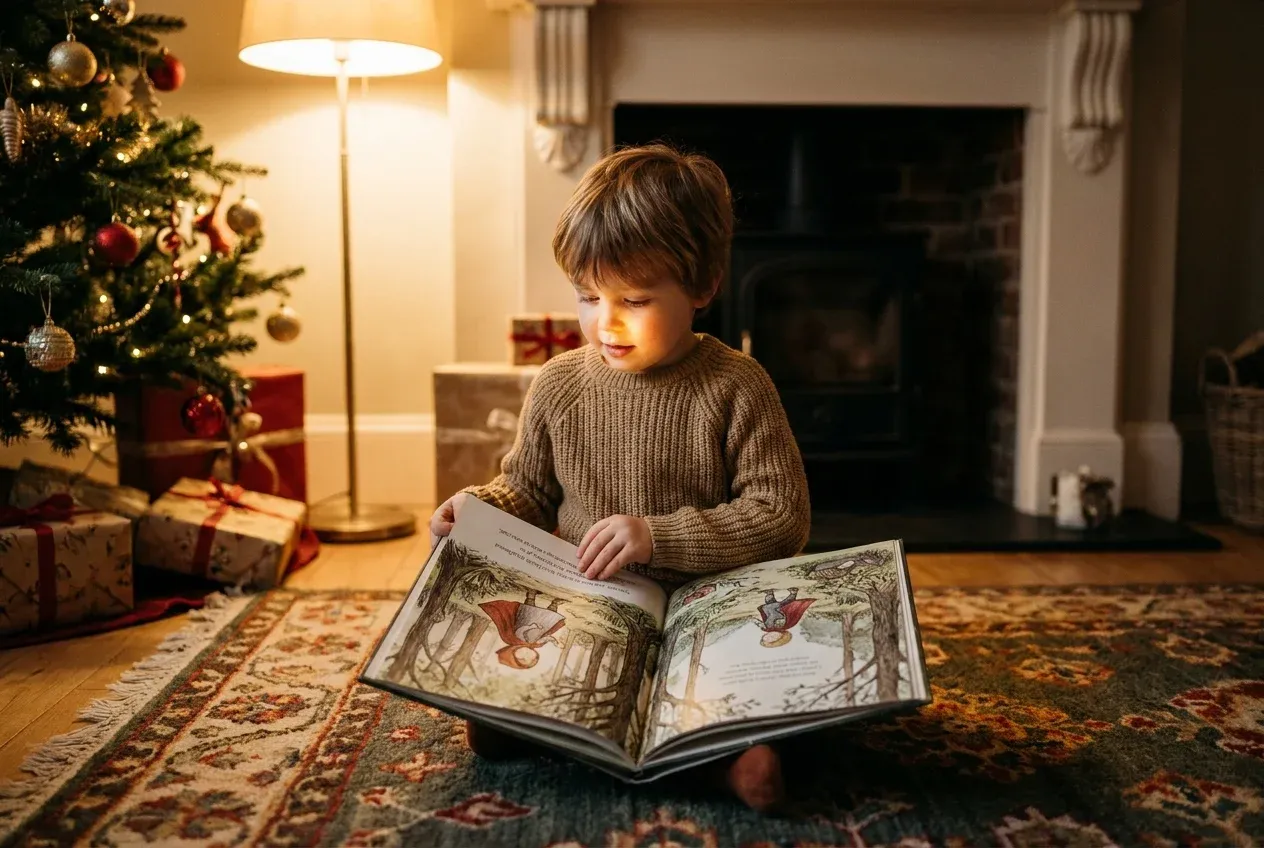
Personalization is a big part of it. Children engage more deeply with stories in which they see themselves reflected — and "reflection" goes beyond just having a character with the same name. When a child opens a book and sees their actual face in the illustrations, something shifts. The story isn't about a character who happens to share their name; it's about them. That kind of engagement doesn't fade after the first read. It invites repeat visits, imaginative play, and the kind of attachment that turns a book into a beloved object.
A personalized book where your child's real face appears in every illustration — starring in a space adventure, a jungle quest, or an underwater kingdom — occupies a different category entirely from even the most beautifully produced mass-market book. For parents who are being intentional about scaling back, it also solves the "but I want it to feel special" anxiety that comes with a smaller gift count. Four gifts, one of which makes your child the literal hero of a story? That's not scaling back. That's scaling up on meaning. If you're looking for the right fit, non-toy Christmas gifts for kids that won't be forgotten by January is worth a read — it covers why experience-and-story-based gifts consistently outlast plastic ones.
Not sure which theme would resonate most? Think about what your child is currently obsessed with. A dinosaur-mad four-year-old will light up differently than a child who's been re-watching every ocean documentary on the shelf. The best "read" gift mirrors where your child's imagination already lives — and then puts them right at the center of it. For more ideas on what works at different ages, last-minute Christmas gifts for kids that still feel deeply personal has practical options even if you're shopping close to the wire.
Frequently Asked Questions
What is the 5-gift rule for Christmas kids?
The five-gift rule adds a fifth category to the standard four: something to do. This could be an experience (a class, a day trip, tickets to something they love), a game to play together, or an activity kit. It's popular with parents who want to include at least one gift that creates a memory rather than an object. For most families, four or five gifts is considered a healthy, non-excessive amount.
Is 20 presents too many Christmas gifts for a child?
For most children, yes — parenting experts generally agree that large numbers of gifts reduce engagement with any individual toy and can actually decrease gratitude and enjoyment. When children are overwhelmed by volume, they tend to move through gifts quickly without truly connecting with any of them. The four-gift rule exists specifically because parents noticed this effect and wanted a way to bring intentionality back to Christmas morning.
What is the 7-gift rule for Christmas?
The seven-gift rule typically expands the four-gift framework with additions like: something to do, something to share (a game or activity for the whole family), and something for their spiritual or creative growth. It's a slightly looser framework than the four-gift rule, and works well for families who find four feels too minimal but still want a guiding structure rather than an open-ended wish list.
How many gifts do most kids get for Christmas?
Many children receive well over ten gifts at Christmas when you account for presents from parents, grandparents, and extended family. Many minimalist-gifting families aim for four to seven from parents and coordinate with relatives to give experiences or consumables rather than adding to the pile. If you're gifting for a child who already has a lot, gifts for toddlers that have everything addresses exactly this situation.
What is the 20 toy rule for kids?
The 20 toy rule is a decluttering principle rather than a gifting rule — it suggests limiting a child's total toy collection to 20 items at any given time. The idea is that children play more creatively and more deeply when they have fewer options to choose from. Parents who follow the 20 toy rule often find minimalist gifting frameworks like the four-gift rule align naturally with their approach: adding fewer, more carefully chosen things rather than rotating a constant influx.
Can the 'read' gift be something other than a regular book?
Absolutely. The "read" category is really about a gift that engages a child's imagination through story and language — so it can include audiobooks, magazine subscriptions, a beautiful illustrated journal, or a personalized storybook. The key is that it invites a child into a narrative world, ideally one they'll want to return to. For children who aren't yet reading independently, a book that features them as the main character — with their real face in every illustration — often creates far more enthusiasm for "reading time" than a generic title.
If you've landed on the four-gift rule and you're thinking carefully about what goes in each slot, the "read" gift is yours to make truly memorable. At Epic Little Hero, parents upload a few photos of their child, choose a theme — Space, Jungle, Ocean, Fantasy, Dinosaurs, or Magic — and receive a beautifully illustrated storybook where their child's real face appears on every page. It's a keepsake that fits perfectly into an intentional Christmas: one book, chosen with care, that a child will ask for again and again. Create your child's personalized book at Epic Little Hero — it takes just a few minutes, and delivery is instant.