Why Kids Light Up When They're the Main Character in a Story
The science behind why children are captivated when they're the hero of a story — and why it goes far deeper than flattery.
You've probably seen it happen in real time. You're reading a story with your child, and the moment they realize the hero shares their name — or better yet, looks like them — something shifts. Their eyes go wide. They sit up straighter. They stop wriggling and start listening with every cell in their body. It isn't a coincidence, and it isn't just flattery working its magic. There's genuine developmental science behind that lit-up face.
Quick answer: Children are wired to pay closer attention to, and remember more from, stories in which they are the main character. Self-relevant information activates deeper cognitive processing — a phenomenon psychologists call the self-reference effect. When a child sees their own face, name, or experiences in a story, their brain encodes it more richly, strengthening comprehension, emotional connection, and confidence. The effect peaks between ages 2 and 7.
If you've ever wondered whether the excitement your child shows is more than a passing thrill, the answer is yes — and it matters quite a lot. Let's look at what's really happening, why it builds confidence, and how you can use this knowledge to support your child's development.
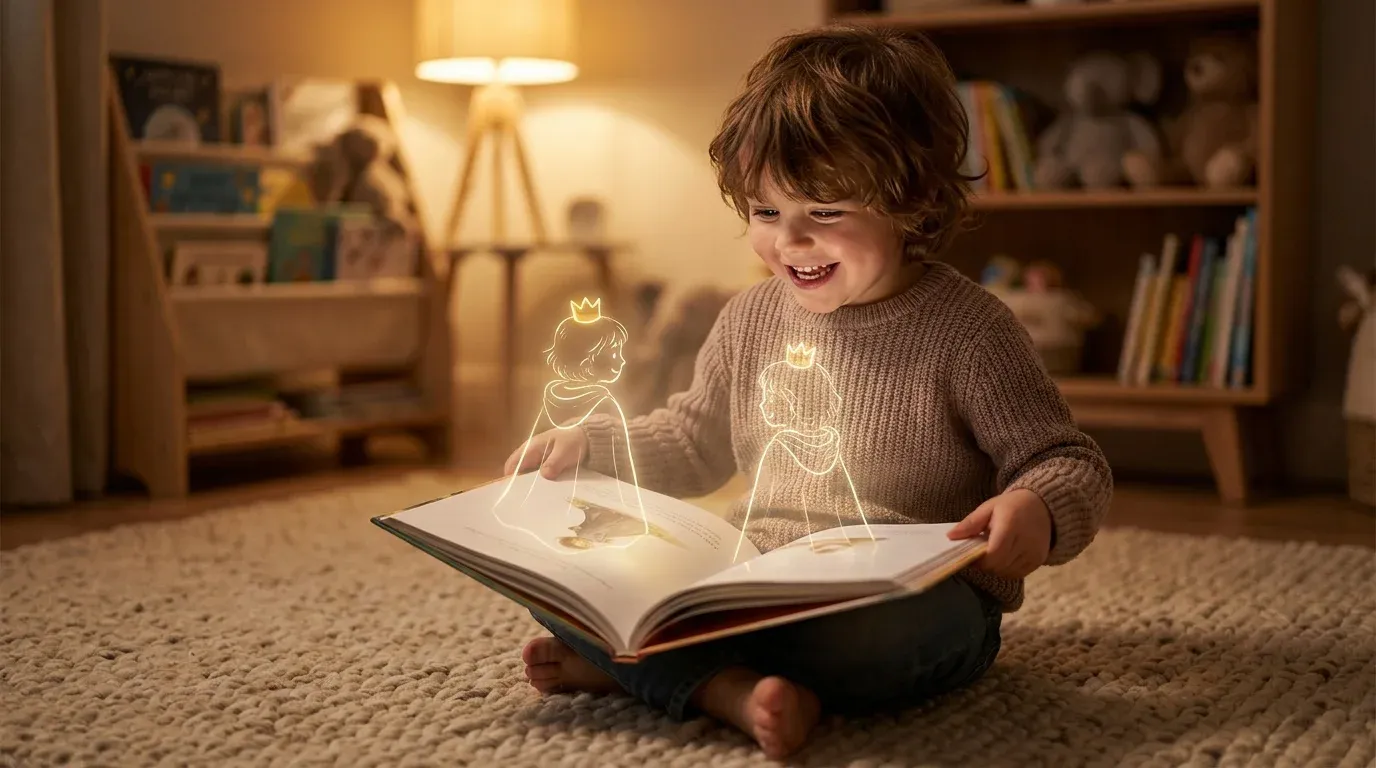
The Mirror Stage: Why Kids Love Seeing Themselves
Developmental psychologists have long recognised that young children are in the active business of building a self. From around 18 months, toddlers begin to pass the "mirror test" — recognising their own reflection as themselves rather than another child. This milestone, known as self-awareness or the mirror stage, marks the beginning of a lifelong fascination with one's own identity. A story that places the child at the centre taps directly into this developmental drive.
Psychologist Erik Erikson described early childhood as the stage where children grapple with autonomy and initiative — essentially asking "Who am I, and can I do things?" Stories are one of the primary ways children try out answers to that question. When the main character IS the child — facing a challenge, solving a problem, going on an adventure — the story becomes a low-stakes rehearsal space for identity. The child isn't just watching someone else be brave. They are being brave, at a safe narrative distance.
This is also why children frequently invent themselves as protagonists in their own imaginative play. "I'm the princess." "I'm the astronaut." The impulse isn't narcissism — it's developmentally appropriate self-construction. A book that meets that impulse where it lives is doing something much deeper than entertaining.
How Self-Relevance Boosts Attention and Memory
The self-reference effect was first described by researchers Rogers, Kuiper, and Kirker back in 1977, and it has since been replicated across age groups and cultures: information processed in relation to the self is remembered significantly better than information processed in any other way. For children, whose working memory and attention spans are still developing, this effect is especially pronounced.
In practical terms, this means a child who hears their own name in a story will track the plot more carefully, recall details more accurately the next day, and request the story again more often. If you've ever been puzzled by why your toddler wants the same book read 47 times in a row, part of the answer lies here — repetition of self-relevant material feels genuinely rewarding to a young brain. We explore that phenomenon in more depth in our post on why toddlers want the same book read over and over.
Now extend that effect from a name to a face. When a child not only hears their name but sees an illustration that genuinely looks like them — same hair, same eyes, same expression — the self-reference signal becomes even stronger. The cognitive resonance is richer, the emotional hook deeper, and the memory trace more durable. Research on pictorial self-recognition confirms that children as young as 2 show measurably heightened engagement with images of themselves compared to images of similar unfamiliar children.
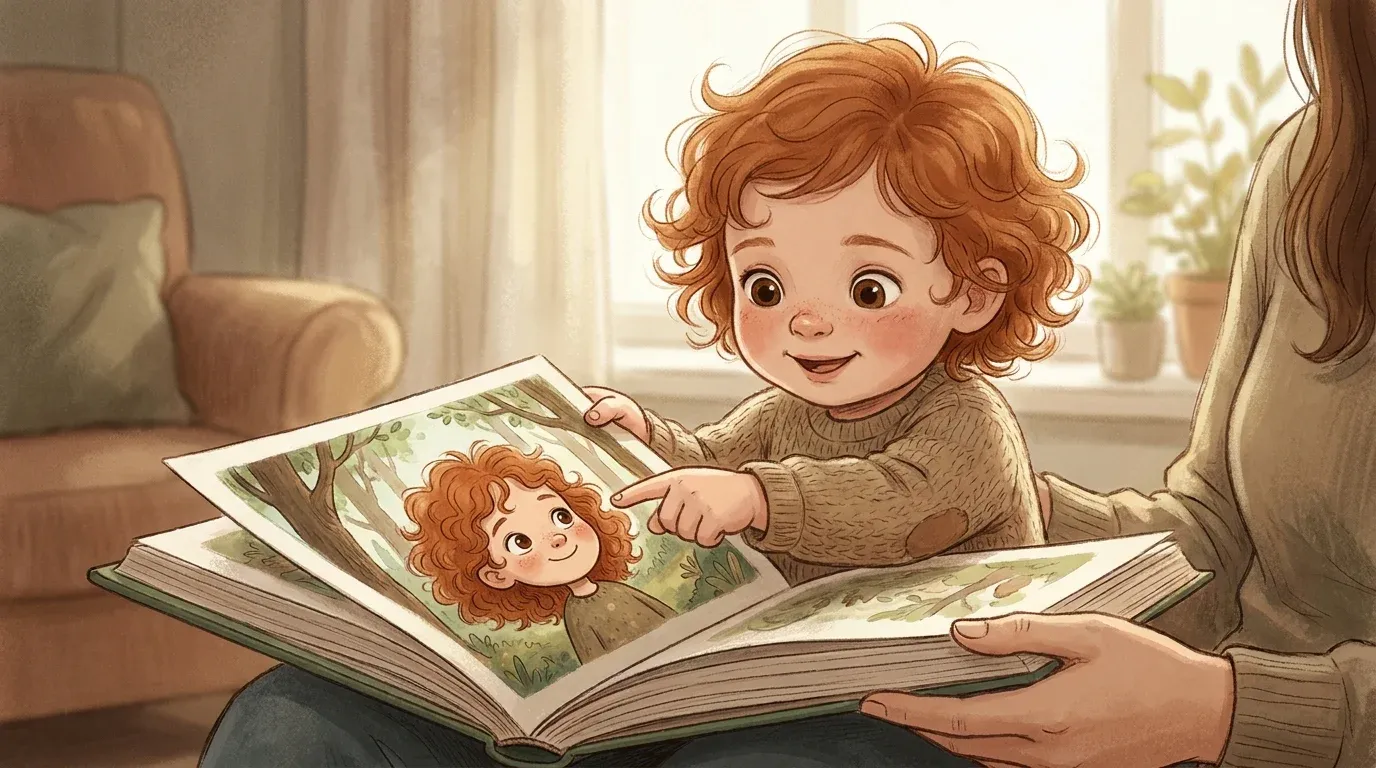
Turning It Into Confidence: The Hero Effect
Here's where the developmental magic really compounds. Stories don't just reflect who a child is — they show who a child can be. When a child repeatedly encounters a version of themselves as capable, curious, brave, and triumphant, those narrative experiences begin to shape their self-concept. Psychologists call this narrative identity: the ongoing story we tell ourselves about who we are. For young children, it is being written fresh every single day.
A child who has "watched" themselves solve a problem in a story has a small but real reference point next time they face something hard. "I went to space and figured it out. I can figure this out." It sounds simple, but the mechanism — vicarious mastery through self-relevant narrative — is well-supported in the literature on self-efficacy. This is also why research consistently finds that children who see characters like them in books develop stronger reading identities and are more likely to seek out books independently. Representation isn't a nice-to-have; it's a driver of engagement. Helping a shy child build confidence often starts with stories in which a child like them overcomes something.
The confidence effect is most potent when the child not only shares the character's name but genuinely recognises themselves visually. The leap from "a character named after me" to "a character who is me" is larger than it might seem. Visual self-recognition activates a more immediate, visceral sense of identification — the child doesn't have to imagine they look like the hero. They can see it.
Frequently Asked Questions
Why does everyone want to be the main character?
It's a deeply human impulse across all ages, but it's especially strong in young children for developmental reasons. Between ages 2 and 7, children are actively constructing a sense of self — who they are, what they can do, where they fit in the world. Stories are one of the primary tools the mind uses for this construction. Being the main character means the story's lessons, victories, and emotional experiences are processed as personally relevant, which makes them more meaningful and more memorable.
What is main character syndrome in children?
The term "main character syndrome" is typically used (often humorously) to describe people who see their own life as the central narrative. In children, the underlying psychology is entirely normal and healthy — it's egocentric thinking, which developmental psychologist Jean Piaget described as a natural feature of early childhood cognition. Young children genuinely cannot fully separate their perspective from others' yet. Rather than a flaw, this is the cognitive architecture that makes self-relevant learning so effective at this age.
Why are main characters important in a story?
Main characters are the reader's point of entry into the story's world. They provide the emotional lens through which events are interpreted. For children specifically, identifying with a main character helps them practise perspective-taking, emotional regulation, and problem-solving — all core developmental tasks. When the main character is the child themselves, that identification is immediate and complete, amplifying all of those developmental benefits.
Does it matter if the main character looks like my child, or is the name enough?
Both matter, but visual recognition adds a meaningful extra layer. Name personalisation is a well-established engagement booster — children respond to hearing and seeing their own name. But pictorial self-recognition, the ability to identify one's own face in an image, emerges earlier than language and activates a more immediate sense of "that's me." A book where the illustrations genuinely resemble your child delivers both signals simultaneously, creating the strongest possible self-reference effect.
From what age does this effect work?
Self-recognition in mirrors typically emerges between 15 and 24 months, and pictorial self-recognition follows shortly after. So even toddlers under 2 show heightened interest in images of themselves. The effect deepens significantly between ages 3 and 6 as narrative comprehension develops, making that window perhaps the richest time to offer a child a story where they are the hero. That said, children up to age 8 or 9 still respond strongly — the self-concept is never fully "finished."
Giving Your Child a Story That's Truly Theirs
Understanding the psychology is one thing. Putting it into practice is another — and the best part is that it doesn't have to be complicated. The simplest, most direct way to give a child the full self-recognition experience in a book is to make one where they are literally the illustrated hero. Not just named, but drawn: their face, their features, their look of determination as they explore the jungle or rocket through space.
At Epic Little Hero, parents upload a photo of their child and our AI generates illustrations where that child's real face appears on every page. The result is the purest possible version of the effect we've been describing: a child who opens the book and sees themselves — unmistakably — as the brave, curious, capable main character. If you're choosing a theme, our guide to picking the perfect story theme for your child can help you match the adventure to what they already love. It's one of those rare gifts where the developmental value and the sheer delight are exactly the same thing. Create your child's personalised book — it takes about five minutes, and the look on their face when they open it lasts considerably longer.