Celebrating Hanukkah and Christmas Together: A Guide for Interfaith Families
Navigating two December holidays with young kids doesn't have to feel like a balancing act. Here's how interfaith families can honor both Hanukkah and Christmas in ways that delight — and don't confuse — little ones.
December in an interfaith household can feel like a beautiful puzzle. Your family holds two traditions — candles and carols, latkes and stockings, prayers from two different histories — and you want your children to feel the full richness of all of it. But when your three-year-old asks "Is tonight Hanukkah or Christmas?" for the fourth evening in a row, the puzzle can start to feel a little daunting.
Quick answer: Celebrating Hanukkah and Christmas together as an interfaith family is not only possible — it can be genuinely meaningful. For young children (ages 2–7), the key is giving each holiday its own clear identity, rituals, and emotional weight rather than blending them into one shapeless "holiday season." When kids understand what makes each celebration special, they don't feel confused — they feel lucky.
This guide is for parents who are figuring it out in real time: what to say, what to do, and how to make both traditions feel honored — not competing. Whether one of you is Jewish and one is Christian, or you're raising children in a household shaped by both faiths, there's a path through December that feels genuinely joyful.
Explaining Two Holidays to Little Kids
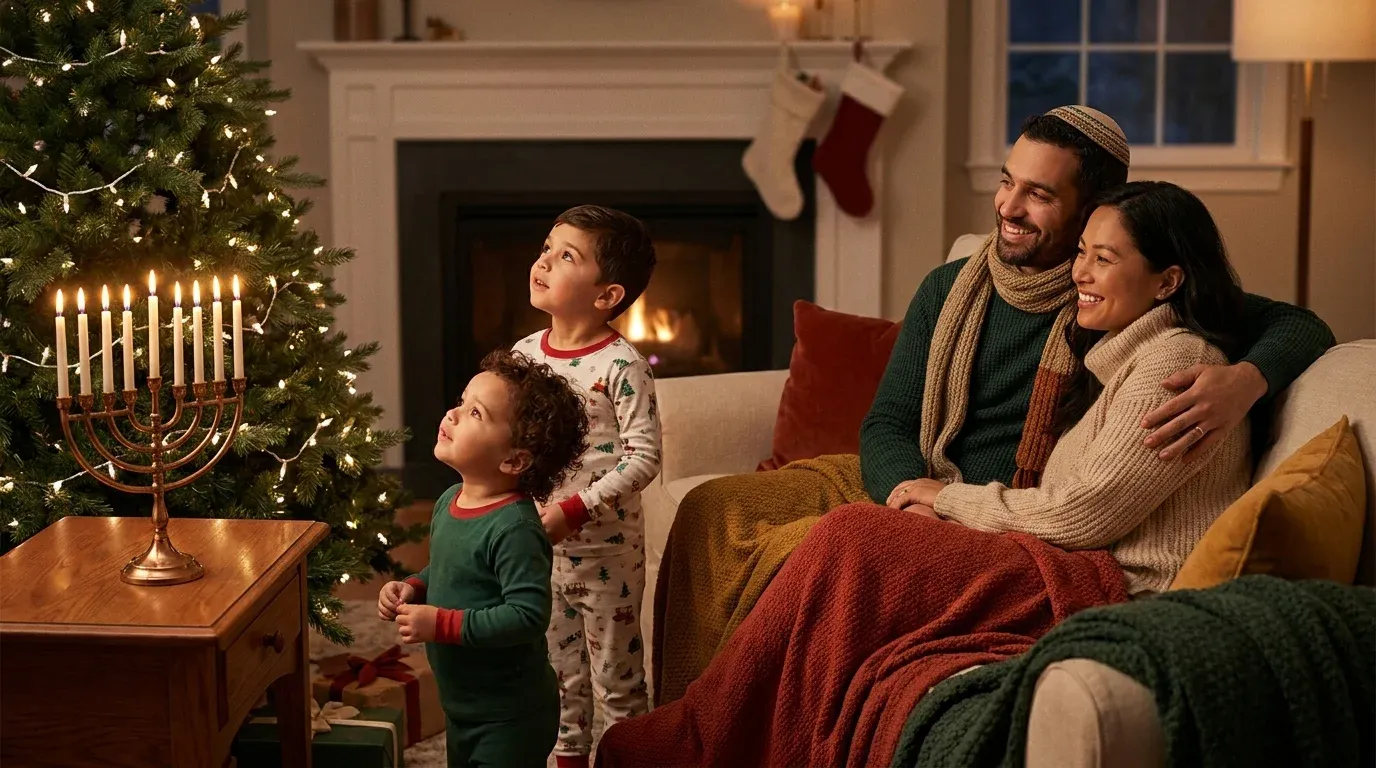
Young children are concrete thinkers. Abstract explanations of faith and history tend to bounce right off a four-year-old, but sensory details stick. So instead of starting with theology, start with what they can see, touch, taste, and do. Hanukkah has the menorah — eight candles, one lit each night, a story about oil that lasted a miracle. Christmas has the tree, the ornaments, the star on top, and the story of a birth celebrated with light in the darkness. Both holidays, you'll notice, center on light during the darkest time of year. That's a genuinely lovely thing to share with a child.
For children under five, it helps to give each holiday its own "home base" in the house. The menorah goes on the windowsill; the Christmas tree goes in the living room corner. When it's time to light the candles, that's Hanukkah time. When it's time to hang ornaments, that's Christmas time. Separate physical spaces and separate rituals prevent the holidays from blurring into each other in a child's mind.
Books are one of the gentlest, most effective tools for this age. Reading stories that reflect your family's exact experience — a family that does both — gives children a framework before the holiday even arrives. Our curated list of the best Hanukkah books for kids for all eight nights includes several titles that work beautifully for interfaith households, with characters and families that look a lot like yours.
Celebrating Hanukkah and Christmas Without Competition
The single biggest mistake interfaith families make in December is treating the holidays as competitors for the same time, the same budget, and the same emotional energy. Children are perceptive — if they sense that one parent is "winning" the holiday season, or that one celebration gets more enthusiasm than the other, they'll start to pick sides. The goal isn't to make every day feel 50/50; it's to give each holiday enough room to be fully itself.
Some practical ways to make space for both without forcing them together into something neither faith would recognize: keep the food traditions distinct and delicious (sufganiyot are not Christmas doughnuts, and gingerbread is not Hanukkah gelt — and that's a good thing). Let each grandparent shine in their own tradition if you're navigating extended family. And resist the urge to invent a merged holiday — the warm portmanteau "Chrismukkah" is fun for adults on TV, but for a toddler trying to understand the world, clarity is kinder than clever.
What works well is finding the genuine overlap: light, gratitude, family gathered, generosity toward others. You can name those themes explicitly without collapsing the two holidays into one. "Both Hanukkah and Christmas are about light" is true and meaningful. "They're basically the same thing" is neither — and kids will eventually call you on it.
Stories That Honor Both Traditions
Story is how young children process everything — family, identity, belonging, and the big questions they don't yet have words for. That's why the books and stories you choose during the holiday season carry more weight than they might seem to. A child who sees a family like theirs in a book — two traditions, two kinds of celebration, loved deeply by people from both — gets something that no amount of explaining can fully provide: a mirror.
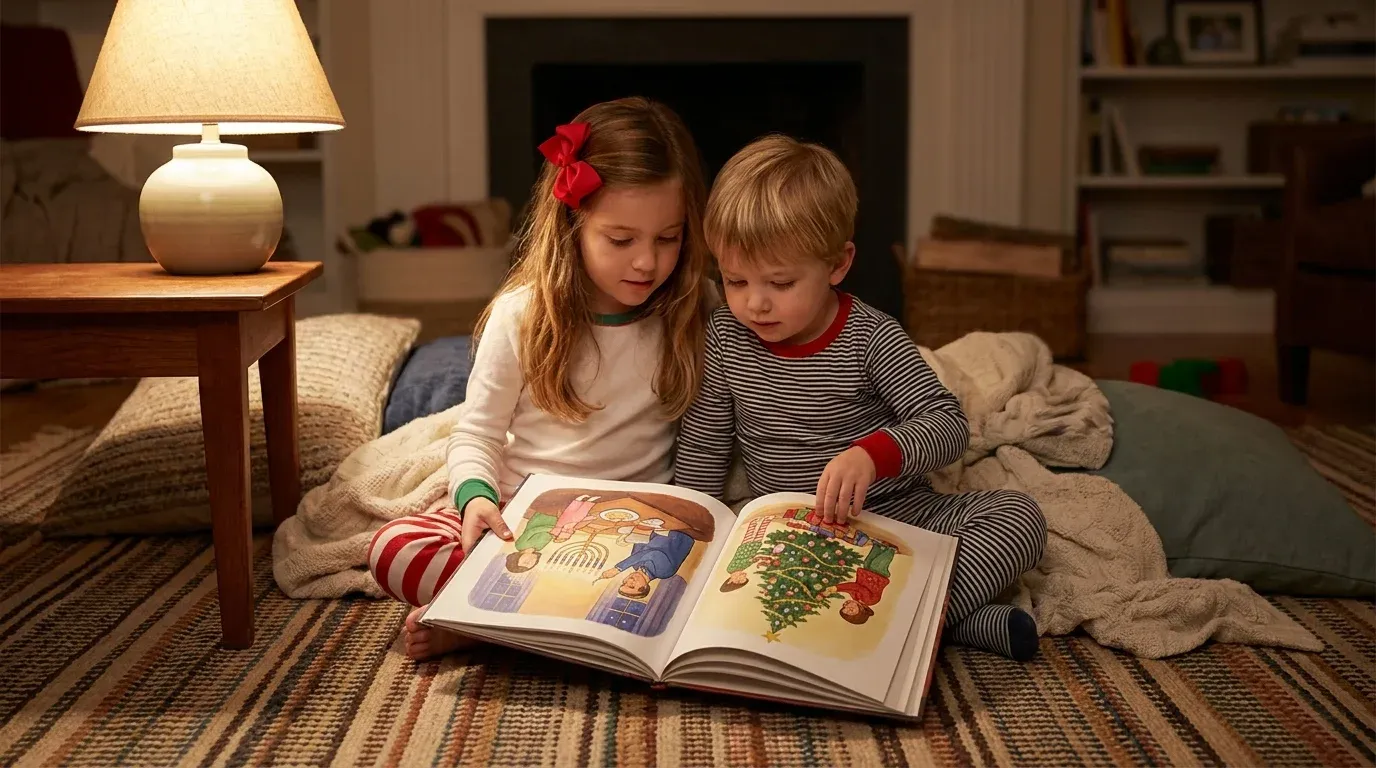
Most children's books about the holidays are written for families that celebrate one tradition. That's fine — there's real value in a purely Hanukkah story or a purely Christmas story. But interfaith families are still underserved by what's on the shelf. One powerful option is a personalized children's book that features your child's real face, where the illustrations show your child's actual likeness and can reflect the real composition of your household — the menorah on the table and the tree in the background, the grandma who lights candles and the grandpa who hangs stockings. When a child sees themselves, their specific family, and both of their holidays inside one story, that's not just cute. It's quietly reassuring: my family makes sense. I belong here.
Stories also give children language. After reading about a character who explains Hanukkah to a Christmas-celebrating friend, a four-year-old will often spontaneously do the same thing at preschool the next week. Narrative is rehearsal — it's how kids prepare for the world. If you're looking for books that help children navigate big feelings during seasons of change and excitement, our guide to books that help toddlers with emotions includes several titles that complement holiday reading beautifully.
For families where grandparents are particularly involved in passing down one tradition or the other, a personalized book can also be one of the most meaningful gifts a grandparent can give — a story starring this child, this family, these holidays. See how it comes together in our guide to personalized books with your child's name and picture.
Frequently Asked Questions
What is Christmas and Hanukkah combined called?
The popular portmanteau is "Chrismukkah," coined in pop culture (notably on The O.C.) and embraced with warmth by many interfaith families. Some families use it affectionately; others prefer to keep the holidays distinctly named to honor both traditions on their own terms. For young children, most child development experts suggest using the actual names — Hanukkah and Christmas — so the holidays each hold their own clear identity in a child's developing understanding.
Can you really celebrate both Christmas and Hanukkah?
Yes — and millions of interfaith families do, joyfully. The key is intention: treating each holiday with genuine respect for its meaning rather than using one as decoration for the other. Hanukkah is a Jewish holiday with its own history, prayers (the blessings over the candles), and foods. Christmas is a Christian holiday with its own traditions and stories. Both can be fully honored in the same household when each gets its own rituals, its own emotional space, and its own explanation for the children.
What is not allowed during Hanukkah?
Unlike the High Holidays (Rosh Hashanah and Yom Kippur), Hanukkah has no religious prohibitions on work or everyday activities — it is not a day of rest in Jewish law. What families are encouraged to do is gather around the menorah each night, say the blessings, and let the candles burn fully rather than blowing them out early. The candles are meant to be displayed publicly (traditionally in a window) to proclaim the miracle, so they're not simply decorative.
How do interfaith families handle gift-giving across both holidays?
This is the practical question most parents are really wrestling with. A few approaches that work well for young children: keep Hanukkah gifts small and meaningful across the eight nights (books, games, experiences) rather than trying to match Christmas-morning energy. Let Christmas be its own singular event. Being transparent with kids — "Hanukkah gifts are smaller, Christmas morning is bigger, and that's our family's way" — is far less confusing than trying to make everything feel equal in scale. Children accept "this is how our family does it" remarkably well when it's said with confidence.
What did Jesus think of Hanukkah? Is there a connection between the two holidays?
This is a question older children and curious adults often raise. Historically, Jesus was Jewish, and Hanukkah (also called the Festival of Dedication) would have been observed during his lifetime — the Gospel of John even references him in Jerusalem during the Festival of Dedication. The two holidays are not theologically connected — Hanukkah commemorates the Maccabean rededication of the Temple in 165 BCE, while Christmas celebrates the birth of Jesus. But the historical overlap is real, and for families exploring both traditions, it can be a point of genuine, age-appropriate conversation as children get older.
Your Family's Story Deserves to Be Told
Interfaith families don't just navigate two holidays — they build something new: a family culture that holds more than one story, more than one kind of light. That's worth celebrating, and it's worth making visible to your children in every way you can. If you'd like to give your child a book where they're the hero of a story that looks exactly like their life — their real face in every illustration, their family, their holidays — create your personalized book at Epic Little Hero. It takes just a few minutes to upload a photo, and what arrives is a story your child will ask to read again and again, long after December has passed.