What Age to Start Reading to Baby? (Earlier Than You Think)
You don't have to wait until your baby "understands" a story. Science says the best age to start reading to your baby is right now — even in the newborn days.
You're sitting in a glider at 2 a.m., newborn on your chest, and someone has suggested you should be reading to this baby — this tiny, blinking, milk-drunk creature who can barely focus on your face. It seems a little absurd. And yet every pediatrician, every literacy expert, and every developmental researcher will tell you the same thing about reading to your baby: yes, now. Start now.
Quick answer: The best age to start reading to your baby is from birth — or even before. Babies in the third trimester can already hear and recognize voices, and newborns respond to the rhythms of language immediately. Your voice, read aloud, is already doing something remarkable in your baby's developing brain.
If that surprises you, you're not alone. Most parents assume reading becomes meaningful around age 2 or 3, once a child can follow a plot and point at pictures. But language development, vocabulary absorption, and the emotional associations a child builds around books all begin far earlier than that. Here's what the science actually says — and what to read at each stage so you feel confident doing it.
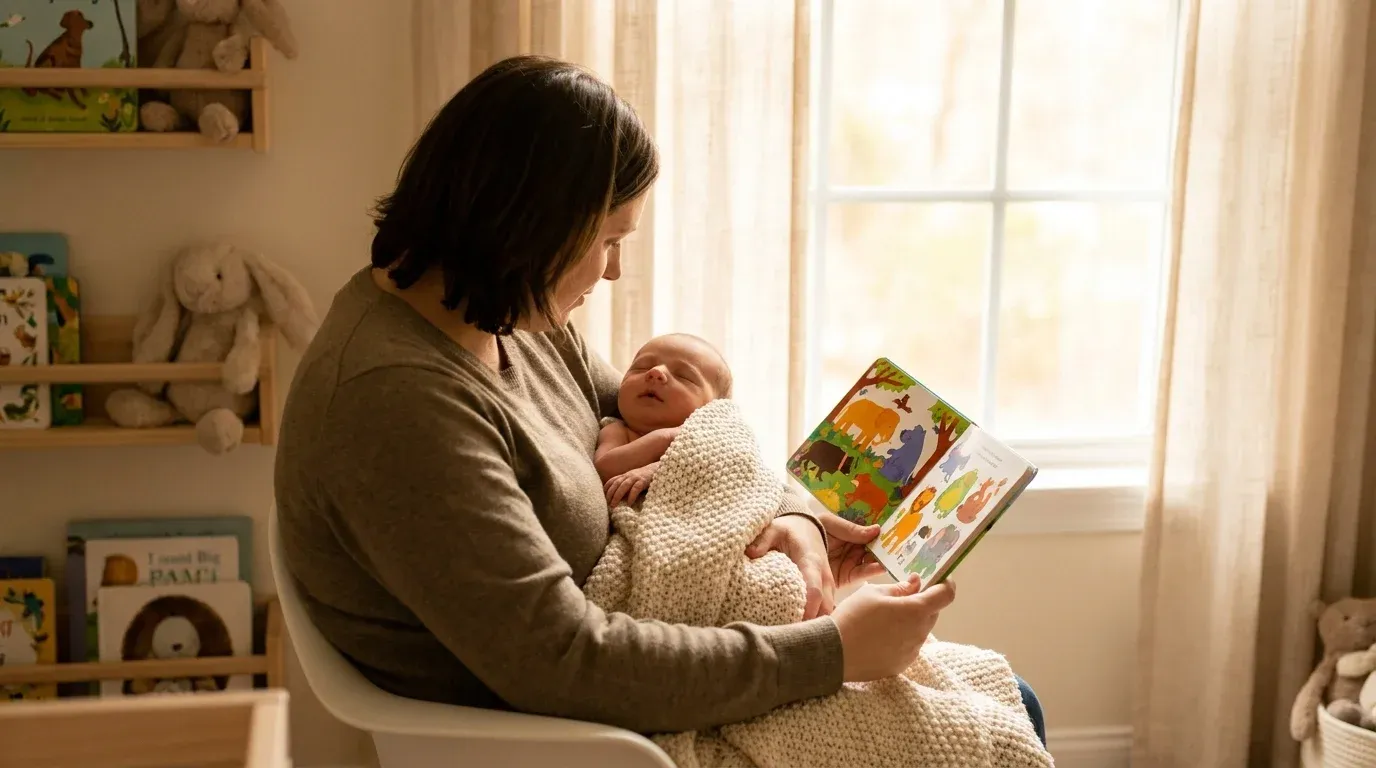
The Best Age to Start Reading to Baby (and Why)
The American Academy of Pediatrics recommends reading aloud to children starting at birth. This isn't a suggestion about future school readiness — it's about what's happening neurologically right now. In the first three years of life, a child's brain forms more than one million new neural connections every single second. Language exposure — even one-sided, even from a board book about a hungry caterpillar — feeds that process directly.
Research consistently shows that children who are read to regularly from infancy enter school with vocabularies significantly larger than peers who weren't. That gap tends to compound: a bigger vocabulary at 5 means faster reading acquisition at 6, which means more confident learning at 7. The foundation is built quietly, in those early months when it feels like nothing much is happening.
But beyond brain development, there's something simpler at work. Reading to a baby teaches them that books mean closeness, warmth, and your undivided attention. That emotional wiring — books = good feelings — is arguably more valuable than any specific word they'll hear. Kids who grow up loving to read almost always had someone read to them lovingly, early on.
What to Read at Each Stage (0–24 Months)
The key insight here is that what you read matters less than how you read it — but some books genuinely work better at different developmental stages. Here's a practical breakdown:
- 0–3 months: Anything, read in a calm, melodic voice. Your newborn is hearing rhythm and intonation, not words. Poetry, picture books, even your grocery list — it all counts. High-contrast black-and-white images hold attention best at this stage.
- 3–6 months: Simple board books with large, bright images and one word per page. Babies start tracking images visually and love books with faces — real or illustrated. They'll grab at pages, which is excellent.
- 6–9 months: Books with textures, flaps, or interactive elements. Babies are now connecting sounds to objects. Repetitive, rhythmic language ('Brown Bear, Brown Bear') is gold — it trains pattern recognition.
- 9–12 months: Start naming everything on the page. 'Dog! The dog says woof.' Point, pause, repeat. Your baby may begin pointing back. This back-and-forth is called dialogic reading and it dramatically accelerates vocabulary.
- 12–18 months: Simple stories with a clear narrative arc. Your baby can now follow simple cause-and-effect ('the bunny is hungry... the bunny finds a carrot!'). Repetition still delights them.
- 18–24 months: Longer stories, books that invite participation ('Can you find the duck?'), and books that mirror their own experiences — bedtime, bath time, meeting a new sibling. At this stage, books that feature a familiar face — like their own — hold attention remarkably well.
If you're wondering whether to worry too much about choosing the 'right' theme, don't. Almost any well-illustrated book works. But if you want a practical guide to matching stories to your child's personality and interests as they grow, this breakdown of how to choose a personalized book theme is worth a read — it applies to early readers just as much as toddlers.
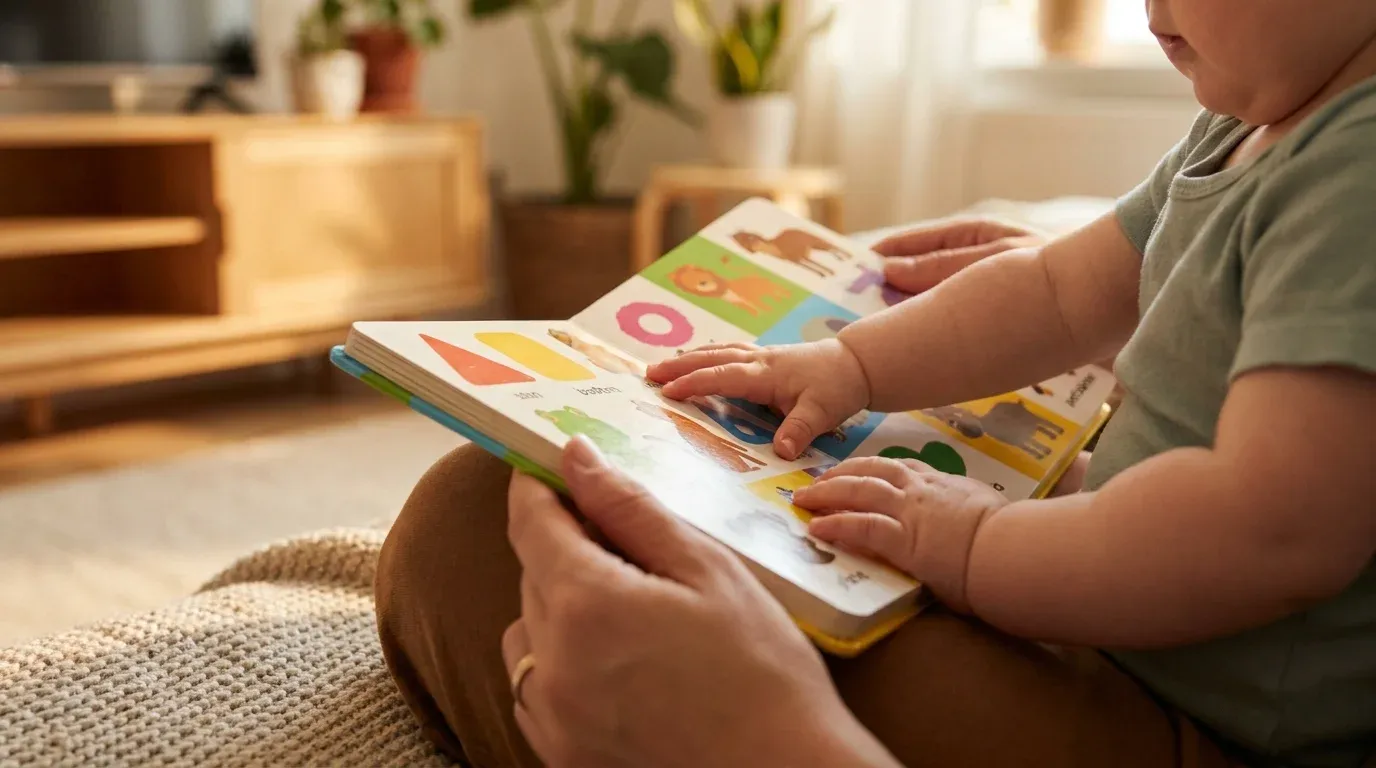
Making Early Reading Stick (Without Making It a Chore)
The number one reason parents stop reading to their babies is that it feels performative. You're reading to someone who is staring at the ceiling fan. You feel slightly ridiculous. And then life happens, the routine slips, and suddenly three months have passed.
The fix isn't discipline — it's anchoring. Attach reading to something that already happens every single day. The most reliable anchors are feeding time (for bottle-fed babies), the wind-down before naps, and the bedtime routine. If you tie books to an existing cue, you don't have to remember to do it. It just happens. A consistent toddler bedtime routine built around books pays dividends for years.
A few small habits that make a real difference in the early months:
- Keep one or two board books in your diaper bag — waiting rooms and car pickups become reading time.
- Read in the same cozy spot when you can. Babies are sensory creatures; the familiar surroundings become part of the ritual.
- Use different voices for different characters, even if you feel silly. The melodic variation captures attention and helps babies distinguish sounds.
- Don't stress about finishing the book. A 4-month-old doesn't need the plot resolution. Read what holds their attention, stop when they're done.
- Let older siblings 'read' to the baby too. It reinforces the habit for everyone and makes the baby feel like a full family participant.
One thing worth knowing: a book that features your baby's own face in the illustrations — rather than a generic character — naturally holds a young child's attention longer. Babies are biologically wired to track human faces, especially familiar ones. A personalized story built around your child gives reading-aloud a uniquely engaging anchor in those early months, something concrete to return to night after night. If you're curious, you can create a personalized book for your baby with their actual face in every illustration — it's become a popular choice for new parents looking for a reading ritual that genuinely sticks.
As your child grows past the baby stage, keeping the momentum going is its own challenge. If you're already thinking ahead, this guide to beating the summer reading slump is full of tactics that work for kids who've drifted away from books — useful to bookmark for the toddler and preschool years.
Frequently Asked Questions
What is the best age to start reading to a baby?
Birth — or even before. Fetuses can hear and respond to voices from around 25–28 weeks of pregnancy, and many parents who read or sing during pregnancy report that their newborns calm to the same stories they heard in the womb. Once born, babies benefit from reading aloud from day one. There is no 'too early.'
Can you read books to a 3-month-old?
Absolutely yes. A 3-month-old won't follow a plot, but they are actively processing the sounds of language, the rhythm of your voice, and the high-contrast images on the page. Board books with simple, bold illustrations are ideal at this age. What matters most is that reading feels like a positive, connected experience — that association is being formed right now.
What is the 5-3-3 rule for babies?
The 5-3-3 rule is a sleep-training guideline — it refers to waiting 5 minutes, then 3 minutes, then 3 minutes before responding during sleep training — and isn't directly related to reading. However, many pediatric sleep consultants recommend incorporating reading as part of a consistent 3-step pre-sleep routine (e.g., bath, book, bed) because predictable rituals help babies settle more easily.
Can babies and toddlers learn to read before age 4?
Not in the conventional sense — decoding written words typically develops between ages 4 and 7. However, 2-year-olds can 'read' books by memory, recognize familiar words by sight, and understand that print carries meaning. By age 4, some children begin sounding out simple words, especially with consistent read-aloud exposure from infancy. All of this pre-literacy awareness is a direct result of being read to regularly — and many children aren't fully reading until 5, 6, or even 7, which is entirely within the normal range.
How many books should I read to my baby each day?
Even one book a day makes a measurable difference. Research suggests that reading just one picture book daily exposes babies to tens of thousands of words per year that they wouldn't otherwise hear in ordinary conversation. If you manage two or three short sessions — one at naptime, one at bedtime — you're already doing more than most. Consistency matters far more than volume.
Start Wherever You Are
Whether your baby is three days old or nine months, the best time to start reading to them is right now. Don't wait for the 'right' book, the right age, or the right routine. Grab anything with pages, settle into your chair, and read out loud. Your voice is the point. The words are just the beginning.
If you want a book that makes reading aloud feel instantly special — one your baby actually looks toward because the little face on every page looks just like theirs — you can create a personalized storybook for your baby in just a few minutes. It's the kind of reading ritual that tends to stick, for babies and for the parents who read to them.