How to Beat the Summer Reading Slump in Kids Who'd Rather Be in the Pool
The summer reading slump is real — but it's not inevitable. Here's how to keep your 5–8 year old's skills sharp when they'd much rather be splashing in the pool.
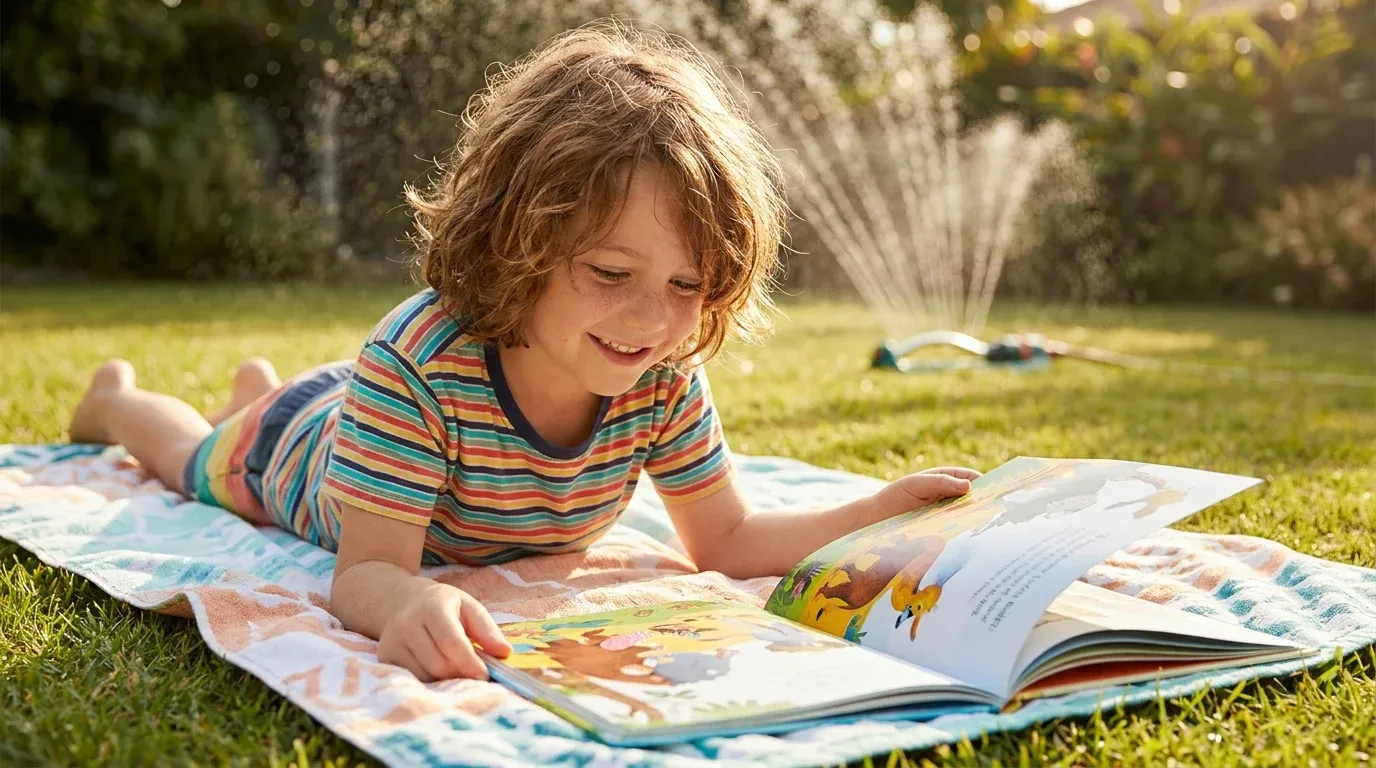
It's the first full week of summer break. The sprinkler is going, the popsicles are melting, and your child is having the time of their life — which is exactly how it should be. But somewhere in the back of your mind, a quiet worry is ticking: they worked so hard this year to get where they are with reading. What happens to all that progress when school is out for ten weeks?
That worry isn't paranoia. It has a name — the summer slide — and the research behind it is pretty consistent. Kids between ages 4 and 8 are at the steepest part of the learning curve when it comes to reading, and long unstructured breaks really can chip away at skills that took months to build. But here's the thing: the solution is not more worksheets, reading logs, or anything that feels remotely like school.
Quick answer: The most effective way to beat the summer reading slump for kids ages 5–8 is to make reading feel like play — not practice. That means ditching the obligation and finding stories your child actually wants to be part of. The rest of this article explains exactly how to do that, in a way that won't cost you a single argument.
What the Summer Slide Actually Does to Young Readers
Researchers who study reading development have found that many children lose roughly one to three months of reading progress over summer break — and that kids in the early elementary years (kindergarten through grade 2) are particularly vulnerable. At ages 5–8, children are still in the process of automating the building blocks of reading: phonics patterns, sight words, fluency, and comprehension strategies. These skills need regular use to solidify. Without it, they can quietly fade.
What's most important to understand is that the summer slide is cumulative. A few weeks of no reading in a single summer isn't catastrophic. But the same pattern repeated across three or four summers adds up to a significant gap by third or fourth grade — often right around the point where reading shifts from a skill being taught to a tool for learning everything else. Falling behind at that hinge point is much harder to recover from.
The good news? Studies also show that reading as few as four to six books over the summer is enough to prevent significant loss. This is not a big ask. It just has to be the right books — books a child is motivated to actually open.
Why Kids Resist Books in Summer (It's Not About Reading)
When a 7-year-old groans at the suggestion of reading in July, they're not being lazy and they're not anti-books. They're doing exactly what their brains are wired to do in an unstructured environment: pursuing fun, novelty, and freedom. School is structured, and books have become associated with school. So in summer, 'go read for 20 minutes' sounds — to a child — suspiciously like homework.
There's also a motivation mismatch that's easy to overlook. Most early chapter books and leveled readers feature characters and worlds that feel generic to a young child. The child doesn't see themselves in those stories. They watch the hero do exciting things and feel like an audience member — which is fine, but it doesn't create the kind of compulsive engagement that makes a kid forget to complain they're bored.
Compare that to the last time your child watched a TV show or movie where someone even slightly resembled them, or shared their name, or was in a situation they recognized. They leaned in, didn't they? Identification is the engine of engagement. The trick to beating the summer reading slump isn't finding a 'good book' in the abstract — it's finding a book that makes your child the point of the whole story. And when a child truly connects with a character, that same identification is also what makes stories so powerful for raising kind, caring kids — something explored in depth in our piece on how reading builds empathy in children.
Stories That Pull Reluctant Readers Back In
If your child is a reluctant reader during the school year, summer is actually an opportunity — not a threat. The pressure is off. Nobody is measuring fluency. That means you have a rare window to rebuild a child's relationship with books purely on the basis of pleasure. Here's what works for kids in the 5–8 range. (And if your child is heading to summer camp, tucking a beloved book into their bag can double as a comfort object — read our guide on emotionally preparing your child for camp drop-off day for more on that approach.)
- Let them choose the topic, not you. A 6-year-old obsessed with dinosaurs will read about dinosaurs. Follow their current obsession, even if you've had enough of T-Rex for a lifetime.
- Read together out loud — don't outsource it. Shared reading at bedtime or in the hammock keeps books tied to warmth and closeness, not obligation.
- Make it short. A picture book finished in ten minutes feels like a win. Five wins beats one abandoned chapter.
- Go places to read. A book at the beach, at a café, in the car — location novelty sneaks in reading without the 'but it's summer' resistance.
- Make the child the main character. This is the single biggest lever for reluctant readers in this age group: a story where they are the hero, with their own face in the illustrations, is impossible to categorize as homework.
That last point deserves more space. When a child opens a book and sees a character who genuinely looks like them — their eyes, their hair, their actual face rendered in the illustrations — something shifts. It stops being a story about someone else. It becomes a story about them. And children who are the protagonists of their own adventures don't need to be persuaded to find out what happens next.
At Epic Little Hero, we built the whole thing around this idea. Parents upload a few photos of their child, and our AI creates a fully illustrated storybook where that child appears as the hero on every page — not just with their name swapped in, but with their actual face in the art. You can explore themes like Space, Fantasy, Jungle, Ocean, Dinosaurs, or Magic, and the book arrives as a print-ready digital PDF from $29, with no subscription needed. A lot of families order one at the start of summer and watch a previously resistant reader ask to look at it again and again. Learn more about what truly sets face-personalized books apart from name-only options in our deep dive: Name on the Cover vs. Their Actual Face Inside.

Beyond personalized books, series work wonderfully for this age group because they create a reason to come back. Once a child finishes one book in a series and likes it, the next is less of a sales job — they already have a relationship with those characters. For 5–6 year olds, look for early reader series with big illustrations and short chapters. For 7–8 year olds, chapter book series with funny, kid-relatable protagonists tend to break through the summer resistance fastest. Our guide to encouraging a reluctant reader at every age has specific title suggestions if you need a starting point.
Frequently Asked Questions
How much reading does my child actually need to do over summer?
Research suggests that reading four to six books over the entire summer is enough to prevent most of the typical skill loss. That averages out to roughly one book every ten to twelve days — far less than most parents fear. Quality of engagement matters more than volume. A child who reads one book they genuinely love retains more than a child who reluctantly plods through five assigned titles.
What is the summer slide and when does it start?
The summer slide refers to the loss of academic skills — particularly reading — that can happen when children go extended periods without practice. It tends to show up most noticeably in early elementary years (roughly ages 5–9) because reading skills are still being built rather than fully automated. The slide typically begins within the first three to four weeks of a school break, which is why early summer is the most important time to establish some light reading habits. If you have a younger child starting preschool in the fall, it's also worth knowing that the return to school brings its own challenges — our guide to back-to-school anxiety in preschoolers covers the signs to watch for and how to help kids ages 3–5 transition with confidence.
My 6-year-old refuses to read anything. What do I do?
Start by removing all pressure and any reading that feels like an assignment. Read to them rather than asking them to read to you. Let them pick anything — comics, joke books, activity books with short text all count. Then look hard at what they're interested in right now and find a book that mirrors that interest. If you can find (or create) a book where they are actually the main character, that's usually the highest-leverage move for a true reluctant reader.
Do audiobooks count for preventing the summer slide?
Audiobooks build vocabulary and comprehension, and they absolutely have a place in a summer reading routine. However, they don't develop the same decoding and fluency skills as print reading for early readers. The best approach is to use audiobooks as a complement — especially for longer stories during car trips — while keeping some amount of print reading in the mix a few times a week.
Can a personalized book really make a difference for a reluctant reader?
For ages 5–8 specifically, yes — the evidence from child literacy research is that reader identity (the sense of 'this story is for me, about someone like me') is one of the strongest predictors of reading engagement. A book where a child is literally the hero, with their own face in every illustration, takes that principle as far as it can go. It's not a replacement for a school reading program, but as a way to make a child want to pick up a book voluntarily during summer — it works remarkably well.
Summer doesn't have to be a trade-off between fun and keeping reading skills sharp. The real trick is refusing to frame it that way to your child — or even to yourself. The pool, the popsicles, and a great story can coexist just fine. If you'd like to create a book where your child is the hero of their own summer adventure, get started at Epic Little Hero — it takes just a few minutes, costs $29, and delivers instantly as a digital PDF your child can carry everywhere (including to the pool). For more ideas on making reading feel special all year round, browse our personalized bedtime stories guide.