Can a Book Build a Child's Confidence? Why Seeing Themselves as the Hero Helps
Books that build confidence in children do more than entertain — the right story gives a shy child a vivid image of themselves being brave. Here's the research behind why it works, and how to choose books that actually move the needle.
If you have a shy or anxious child, you already know that praise only goes so far. You can tell them they're brave a hundred times before breakfast — and it might not land. But sit them down with the right story, and something different happens. They lean in. They root for the hero. And quietly, without any prompting from you, they start to wonder: could I do that too?
That's not a coincidence. Psychologists have studied how narrative — the experience of living inside a story — shapes a child's developing sense of self. The books a child reads during their early years aren't just entertainment. They're a mirror, a rehearsal space, and sometimes, a blueprint for who they decide to become.
Quick answer: Yes, books can meaningfully build confidence in children — especially when the child sees a character who looks and feels like them facing fear and succeeding. Children form their self-concept partly through the stories they absorb. A child who watches a hero overcome doubt internalizes the possibility that they can too. When the hero literally looks like them, that message becomes even harder to dismiss.
How Stories Shape a Child's Self-Image
Children are remarkably literal about the stories they consume. When a young child watches a character navigate a scary situation — a dark forest, a new school, a big challenge — their brain doesn't fully separate "that character" from "me." Research on narrative identity suggests that from as early as age three, children begin weaving stories into their sense of who they are. The characters they admire aren't just fictional; they become reference points. "I want to be brave like her." "He was scared and he did it anyway — maybe I can too."
This is why the stories we put in front of young children are worth thinking about carefully. A child who only ever sees bold, naturally confident heroes may quietly conclude that bravery is a personality trait you're born with — not something you build. But a child who sees a hero who was nervous, who hesitated, who almost turned back — and then took the step anyway — learns something far more useful: courage isn't the absence of fear. It's what you do with it.
Stories also give children language for emotions they can't yet name. As explored in our guide to books that help toddlers with emotions, the right story can do what a hundred calm reminders can't — help a child recognize a feeling, name it, and watch a character move through it. That's the first step toward believing they can do the same.
Why Seeing Yourself Succeed in a Story Actually Works
There's a concept in developmental psychology called "narrative transportation" — the experience of being so absorbed in a story that you temporarily inhabit the character's perspective. For adults, this is pleasant. For young children, it's nearly complete. A five-year-old doesn't watch the hero escape the dragon; in a meaningful psychological sense, they escape the dragon. And when they close the book, a residue of that experience stays with them.
This is the mechanism behind why books that build confidence in children work better than straightforward praise. Telling a child "you're so brave" is abstract. Watching a character who feels exactly how they feel — uncertain, small, unsure — and then seeing that character succeed, is concrete. It gives confidence a vivid image to attach to. The child's brain essentially rehearses the experience of being brave.
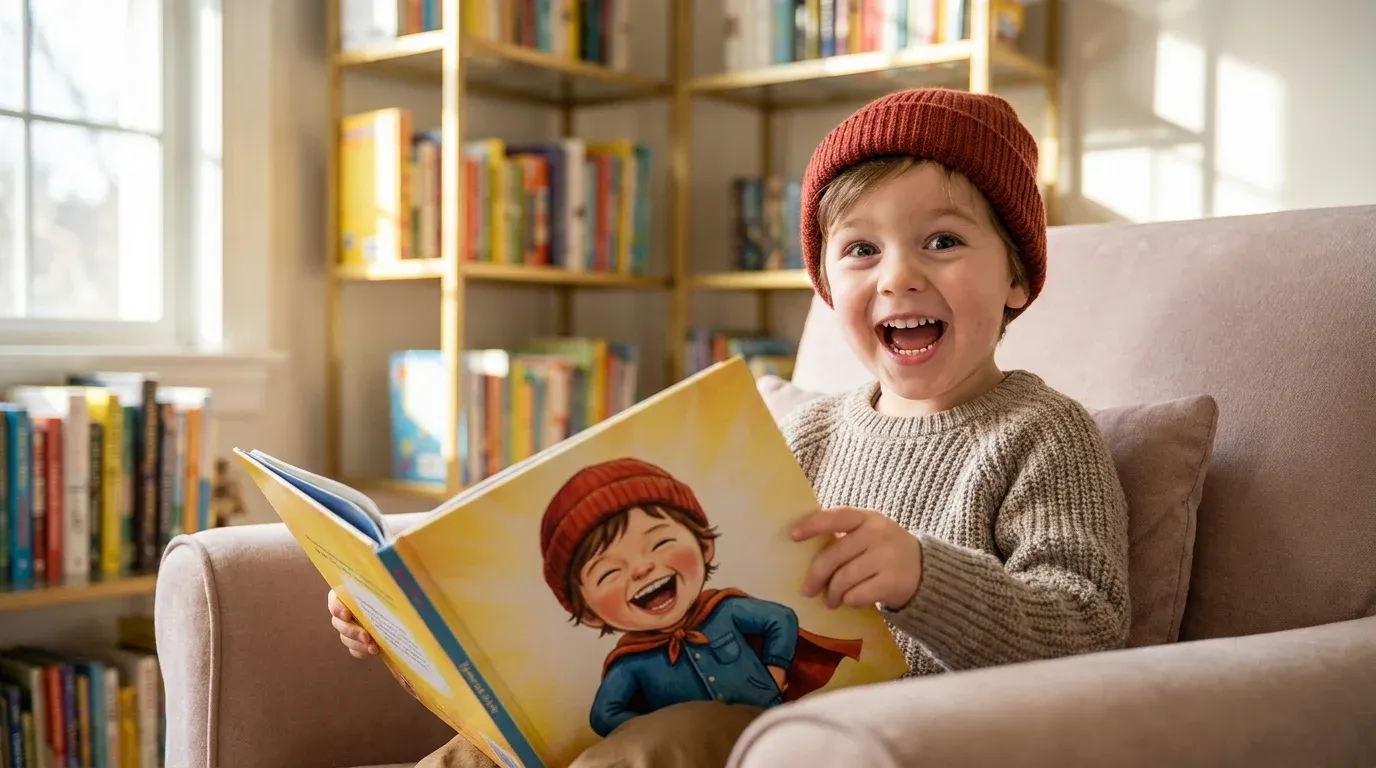
Now take that one step further. What happens when the character isn't just emotionally similar to your child — but literally looks like them? When a child opens a book and sees their own face on the hero soaring through space, or leading a quest through an enchanted forest, the identification becomes complete. There's no mental leap required. "That's me" isn't a metaphor — it's just true. And with that recognition comes something powerful: a vivid, visual memory of themselves being the brave one. That's the idea behind why kids light up when they're the main character in a story — and why the effect runs deeper than novelty.
How to Choose Books That Actually Build Confidence in Children
Not all books marketed as "confidence-building" deliver equally. Some are really just cheerful stories about naturally plucky kids — which is lovely, but doesn't do much for a child who doesn't see themselves as plucky. When choosing books that build self-esteem and confidence in children, here's what to look for:
- A hero who starts from a place of doubt or fear — not effortless confidence. The transformation is the lesson.
- Challenges that feel real to your child's world — social situations, new experiences, being different, trying something hard.
- Emotions named explicitly, not just implied. Children need vocabulary for what they're feeling before they can manage it.
- A resolution that comes from the character's own courage — not a magical rescue. Your child needs to see that it was the hero's choice that made the difference.
- Characters who look like your child — in age, in temperament, ideally in appearance. Representation in story is more than a cultural nicety; it's a psychological shortcut to identification.
- Language at or just above your child's reading level, so they're challenged without being frustrated.
One important note on self-esteem books for children: books that simply tell a child they're wonderful — without any challenge or growth arc — can actually backfire. Carol Dweck's decades of research on praise and self-concept suggests that children need to see effort and struggle rewarded, not just innate greatness. A confident child isn't one who's been told they're perfect; it's one who's learned, story by story, that facing hard things is survivable — and often worth it.
You can also pair story-reading with conversation. After finishing a book, ask: "Was there a moment when [character] felt scared? What did they do?" Then: "Has something ever felt like that for you?" This transforms the reading session from passive to active — your child becomes the analyst, not just the audience. Stories that build empathy naturally support this kind of reflection, which is why reading builds empathy in children in ways that straightforward instruction rarely can.
Frequently Asked Questions
How do you build confidence in children?
Confidence in children grows from repeated small experiences of facing something hard and surviving it — not from being told they're capable. Practical approaches include: giving children age-appropriate challenges to solve themselves, praising effort over outcome, letting them experience manageable failure without rescue, and — importantly — surrounding them with stories where characters like them face fear and succeed. Books are particularly powerful because they let children rehearse bravery in a safe, low-stakes way before they're asked to be brave in real life.
What is the best type of book to improve self-esteem in a child?
The most effective books for building self-esteem in children share a few traits: the hero begins from a place of self-doubt (not ready-made confidence), the challenge they face feels emotionally real, and the resolution comes from the character's own courage rather than outside rescue. Books where the child reader can see themselves in the hero — either through similar personality, similar fears, or literal appearance — are consistently more impactful than generic confidence tales, because identification is the mechanism through which the story's lesson transfers.
What are the 5 C's of confidence in children?
The 5 C's framework (often cited in positive youth development) identifies: Competence (experiencing real success), Confidence (an internal sense of capability), Connection (feeling securely attached to others), Character (a stable sense of values), and Contribution (feeling that they matter to something larger than themselves). Well-chosen stories can nurture all five — a hero's journey builds competence and confidence vicariously, while themes of friendship, belonging, and purpose speak to connection, character, and contribution.
At what age do books start building a child's confidence?
Earlier than most parents expect. By age two, children are forming a self-concept — a sense of who they are and what they can do. Toddlers who are read to regularly begin to identify with characters and absorb simple emotional lessons ("the bunny was scared, but tried anyway"). By three to four, children can explicitly discuss a character's feelings and compare them to their own. The confidence-building effect of books compounds over time: the more stories a child has of heroes overcoming doubt, the richer their internal reference library becomes.
Can a personalized book really make a difference for a shy child?
The research on identification and narrative transportation suggests yes — and the logic is straightforward. The harder a child has to work to see themselves in a character, the weaker the psychological transfer. A book where the hero has a different name, different appearance, different life? The shy child watches from a distance. A book where the hero literally has their face — navigating a scary adventure and coming out braver on the other side — removes that distance entirely. The child isn't reading about bravery. They're watching themselves be brave. That's a meaningfully different experience.
Give Your Child a Story That Says: You Are the Brave One
If you have a child who doubts themselves — who hangs back, who says "I can't" before they've tried, who needs to see it to believe it — then the most powerful thing a book can do is show them their own face on the page of a hero. At Epic Little Hero, parents upload a photo of their child, and our AI illustrates an entire adventure where their child's real face appears in every scene — soaring through space, exploring jungles, defeating dragons. Not a character who shares their name. Them. Starting at $29, with instant digital delivery, it's the kind of gift that doesn't sit on a shelf — it sits in a child's memory of who they are. Create your child's personalized storybook — and give them a vivid, permanent image of themselves being brave.