Building a Home Library for Toddlers (Without the Overwhelm)
You don't need 200 books to raise a reader. Here's the curated starter-shelf approach that builds real reading habits — one category at a time.
You bring your baby home, and somewhere between the sleep deprivation and the diaper changes, someone tells you to "read together every day." Great advice. Genuinely. But then you look at the parenting blogs and the well-meaning Amazon lists, and suddenly it feels like you need a dedicated room, a cataloguing system, and a small inheritance to do it properly.
Here's the truth: building a home library for toddlers doesn't require quantity. It requires a little intention. The parents who raise the most enthusiastic young readers aren't the ones with the biggest shelves — they're the ones who chose a handful of the right books and actually opened them.
Quick answer: A strong toddler home library needs just 10–15 books across four core categories — sturdy board books, rhyming books, concept books, and one deeply personal story that belongs entirely to your child. Start there. Add slowly. Your toddler will love three books they know by heart more than thirty they've never touched.
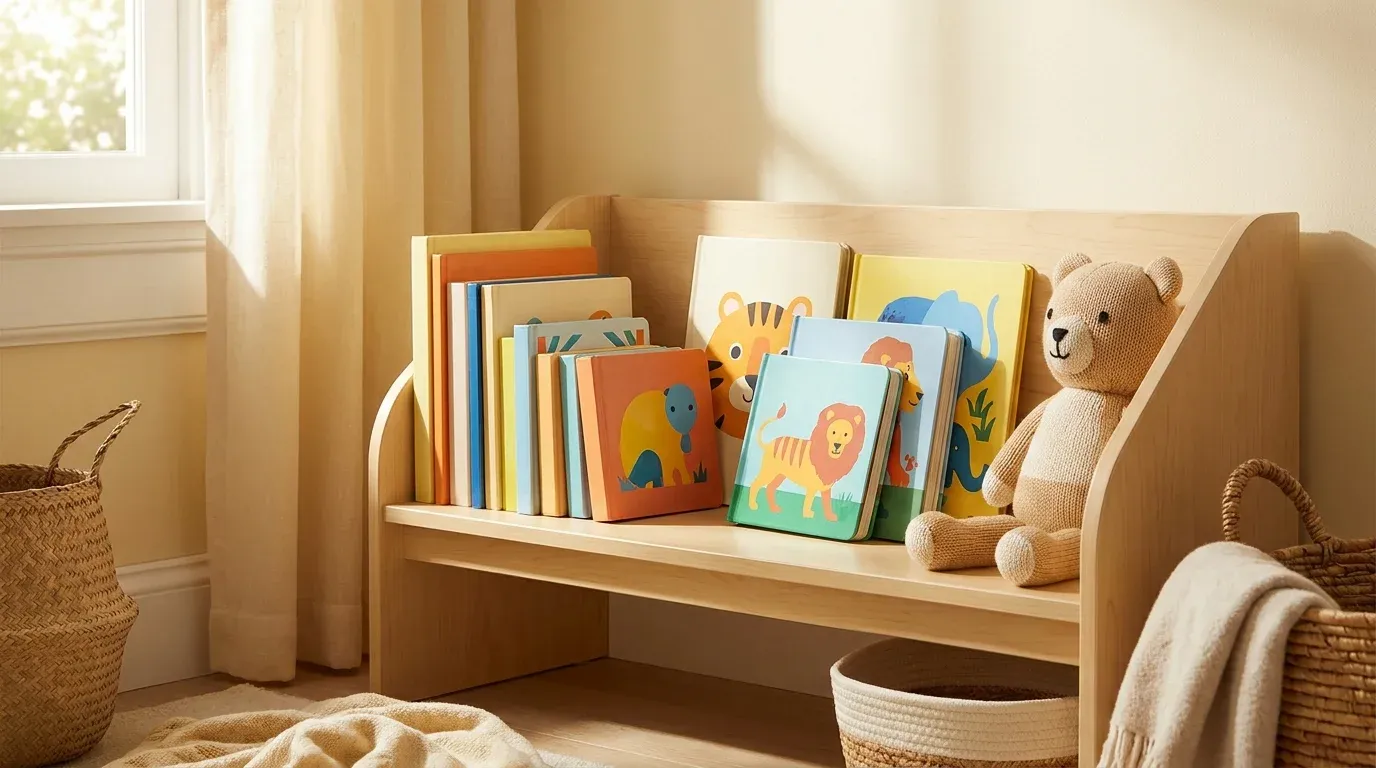
The Core Categories Every Shelf Needs
Think of your toddler's starter shelf as a balanced plate — each category serves a different purpose, and together they cover everything a young reader needs. You don't need multiple books from each type right away. One or two strong picks per category is more than enough to begin.
- Board books: Indestructible, chewable, and perfect for babies and young toddlers. These are the books that get read on the floor, in the car, and in the bath. Classics like The Very Hungry Caterpillar and Goodnight Moon exist for a reason — they work. Add one or two favorites and let them get wrecked.
- Rhyming and rhythm books: Toddlers are wired for sound patterns. Books with strong rhyme and repetition (think Brown Bear, Brown Bear) build early phonological awareness — the skill that directly predicts how easily a child learns to read. One or two good rhymers punch well above their weight.
- Concept books: Colors, shapes, numbers, opposites — these are the books that make "learning" feel like play. Simple, bright, and short. A toddler doesn't need a curriculum; they need a grown-up pointing at a yellow circle and laughing with them.
- Bedtime or emotional books: Stories that help toddlers name big feelings or wind down at the end of the day. These do double duty: they support emotional development and make the bedtime routine something your child actually looks forward to.
- One anchor book — more on this below.
That's it. Five slots. If you have one solid book in each of these categories, you have a starter shelf worth being proud of. As your child grows and interests emerge — dinosaurs, outer space, animals — you can add to individual slots naturally, without ever feeling like you're behind. The transition into a new school year is one of the best natural moments to refresh the shelf — if you're looking for ways to mark the season, the end-of-summer toddler bucket list is a lovely companion read. And once the leaves start turning, the fall bucket list for toddlers is full of cozy seasonal activities — including rainy-day stories — that pair beautifully with a fresh book or two.
Choosing Books for Your Home Library for Toddlers (Quality Over Quantity)
The books that collect dust are almost never the ones your toddler chose — they're the ones you bought because they seemed educational, or because they were on a list, or because they were on sale. Toddlers are brutally honest curators. They will tell you, loudly and clearly, which books they want read again. (And again. And again. And again — but that's a whole other story.)
A few guidelines that actually work in the real world: Choose books with fewer than 200 words for ages 1–2, and up to 400–500 words for ages 2–3. Look for illustrations that are clear and expressive, not cluttered. Read the first page aloud before you buy — if it flows naturally off your tongue, it'll survive the 47th read-through. If it feels awkward at first glance, it'll feel worse at midnight.
Budget-wise, building a home library for toddlers doesn't mean buying everything new. Library cards are free and often include digital lending apps like Libby. Secondhand board books from thrift stores are usually in excellent condition (they're basically tanks). The goal is a shelf of 10–15 books your toddler loves, not a comprehensive archive. If you're working with the 5-gift rule for toddlers, one of those slots pairs beautifully with a great book — you can read more about how to make each gift count with the 5-gift rule for toddlers.
The One Personal Book Every Library Needs
Here's something worth sitting with: your toddler can sense the difference between a story that was made for any child and a story that was made for them. The moment a book uses their name, shows a character who looks like them, or reflects something from their own life — the engagement shifts. Their body leans in. They point at the page and say, with complete certainty, "That's me."
This is why every great toddler library deserves one book that's genuinely, deeply personal. Not just a name printed on the cover (which toddlers largely don't register), but a story where the child is truly the hero — and looks like it. At Epic Little Hero, parents upload a photo and AI generates full illustrations where the child's real face appears on every page, inside a story set in a world they love: outer space, a jungle adventure, an underwater kingdom.
This becomes the anchor title. The one they reach for first. The one that makes reading feel like it's about them — because it is. It also does something quietly powerful for confidence: children who see themselves as the capable hero of a story start to believe they might be that hero in real life, too. If you're curious how this works for children who are a little more hesitant, there's a really good piece on helping shy children build confidence that touches on exactly this. For help picking the right story world, the guide on choosing a personalized book theme for your child walks through every option.
A personalized storybook from Epic Little Hero starts at $29 — less than most plastic toys that'll be forgotten in a week — and delivers as an instant digital PDF, ready to print at home or at any print shop. One book. Maximum impact. Perfect anchor for a shelf you're just starting to build.
Frequently Asked Questions
How many books should a toddler have at home?
Having around 20 books in the home is widely considered a meaningful foundation for children's literacy — but for a toddler's starter shelf, 10–15 well-chosen books is a completely solid start. Focus on books across the key categories (board books, rhymers, concept books, emotional books, and one personal story) rather than accumulating volume. A toddler with 12 books they love will develop stronger reading habits than one with 80 books they've never touched.
What age should I start building a home library for my toddler?
The moment a baby is born is a fine time to start. Newborns benefit from hearing language, even before they can interact with a book. For practical library-building purposes — choosing books a child will actually engage with — the 6–18 month window is a great starting point for board books, with picture books and rhymers following naturally as they move into toddlerhood. The earlier you make books part of the daily environment, the more normal (and desirable) they feel to a growing child.
How do I build a toddler library on a budget?
Start with your local library — a free card gives you access to hundreds of books, plus digital lending apps. Supplement with thrift store board books (they're indestructible and often cost under a dollar). Buy new only for the books you know your toddler loves and will want to own permanently. For the one book worth spending on, a personalized storybook that features your child's real face is a one-time purchase that tends to stay in rotation for years — far better value than a dozen forgettable paperbacks.
What makes a good toddler book?
For ages 1–2: durable format (board book), simple clear illustrations, very short text (under 200 words), repetition and rhythm. For ages 2–3: slightly longer narratives are fine, but strong illustrations and a satisfying emotional arc still matter more than word count. The best signal is whether your toddler asks to hear it again — that's the only endorsement that actually counts.
What's the best gift for a toddler who loves stories?
A personalized storybook where the toddler is the main character — and where the illustrations actually look like them — consistently tops the list for parents and gift-givers looking for something that lasts. Unlike toys, it doesn't require batteries, doesn't break, and doesn't end up donated after six months. If you're shopping for a child who already has plenty of toys and books, you might also find ideas in the guide to gifts for kids who have everything. And if the child is navigating a big upheaval like a house move, the guide to finding a meaningful gift for a child moving to a new home explains how a familiar, personal story can be especially grounding during that transition.
If your little one seems resistant to books in general, don't worry — that's more common than you think, and it's almost always fixable. The post on how to encourage a reluctant reader has age-by-age tactics that genuinely work.
Ready to Add the Anchor Book?
You've got the framework. Now all that's left is filling the shelf — one good book at a time, starting with the one that's made entirely for your child. Upload a photo, choose a story world they'll love, and in minutes you'll have a personalized storybook where your toddler is the hero of every illustrated page. Create your child's book at Epic Little Hero — it takes about five minutes, starts at $29, and becomes the book they ask for every single night.