Indoor Activities for Toddlers This Winter (Low-Prep Rescue List)
When it's too cold to go outside and the walls are closing in, here's a low-prep rescue list of indoor activities for toddlers in winter — including the one quiet activity that reliably resets even the stir-craziest afternoon.
You checked the forecast. Again. Still 19°F, still gusty, still very much a "not going outside" kind of day. Your toddler — already an expert in indoor activities, whether you planned them or not — has lapped the living room fourteen times, flung a sock across the kitchen, and attempted to climb the bookshelf. They just need to move, explore, and feel like something interesting is happening. Right now, that's entirely your job.
In short: The best indoor activities for toddlers in winter mix short bursts of big movement with sensory play and at least one calm, restorative activity to close out the energy. You don't need a craft supply haul or a Pinterest board — just a loose rotation and a few reliable go-tos.
Below is exactly that: a practical, low-prep rescue list organized by energy level, plus the one quiet activity that reliably brings even the stir-craziest afternoon back to earth.
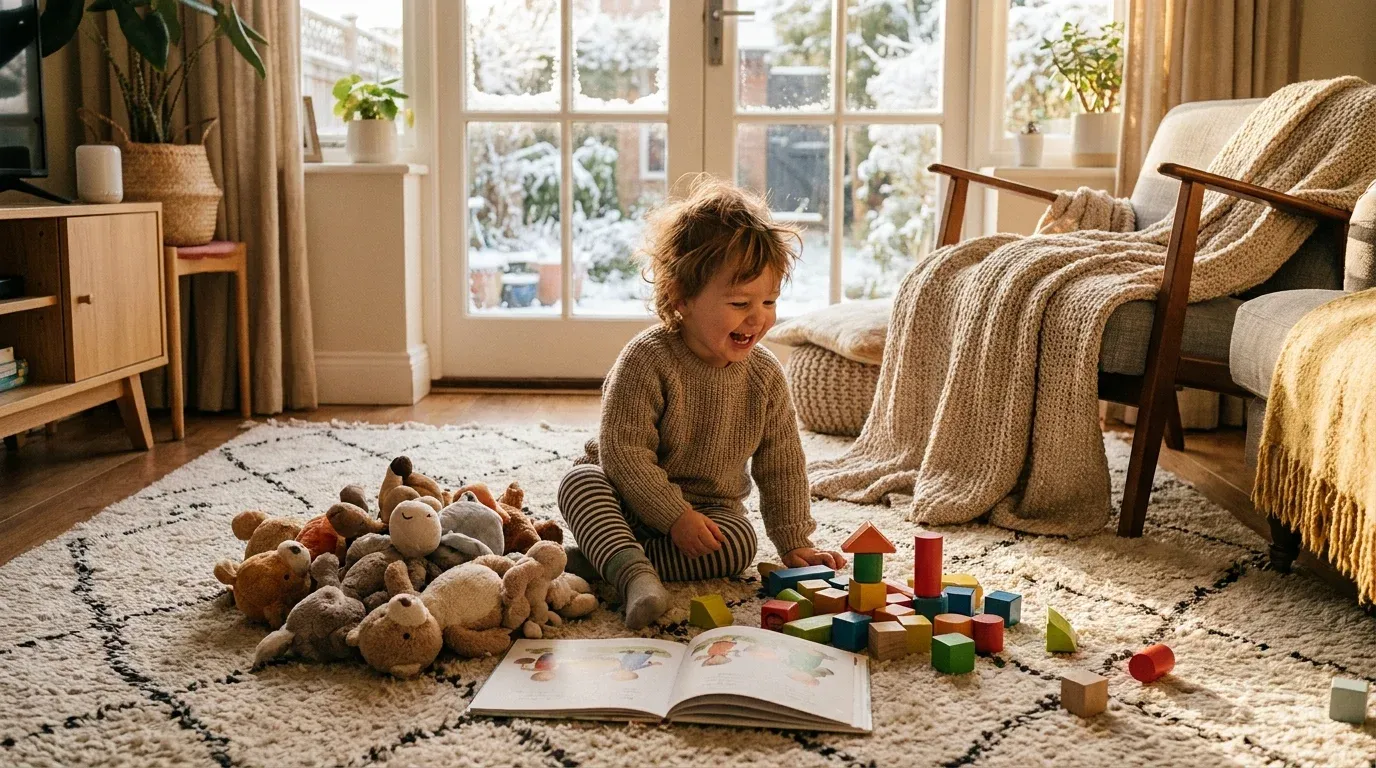
Indoor Activities for Toddlers Who Need to Move
Toddlers between one and four years old are biologically wired to move. When outdoor time disappears, that energy doesn't disappear with it — it just redirects, usually at your furniture. The trick is to give that urge a container before it finds one on its own.
None of these require special equipment, a big house, or more than two minutes of setup. The goal is a short, satisfying burst of movement — enough to take the edge off so your toddler can actually settle into something calmer afterward.
- Freeze dance: Play any song they love, pause it suddenly, and freeze. Toddlers find this endlessly funny. Two-year-olds especially love being the one who "wins" by freezing fastest.
- Pillow obstacle course: Line up couch cushions on the floor as stepping stones, tunnels, or jumping targets. Reset takes five seconds.
- Balloon keep-up: A single balloon, the goal of not letting it touch the floor. Works for a surprising number of minutes.
- Bear crawl races: Get on all fours and race across the room. They will beat you. Let them.
- Indoor bowling: A few empty water bottles and a soft ball. Set it up in the hallway for a natural lane.
- Sock skating: Put socks on a wood or tile floor and slide. Supervision required, chaos guaranteed, fun delivered.
- Couch jump: Designate one cushion as the official jumping zone. Controlled chaos is better than uncontrolled chaos.
- Yoga for toddlers: "Elephant trunk," "snake on the floor," "tree pose." YouTube has free guided sessions; toddlers love the animal names.
A note on screen-free movement: the activities above are almost entirely parent-optional — your toddler can run the obstacle course solo while you stand nearby with your coffee. That said, the ones you participate in, even briefly, tend to land better and end more peacefully. Five minutes of bear crawl races counts.
Calm-Down and Quiet-Time Ideas
Once the physical energy has had its outlet, there's usually a short window — maybe ten, maybe twenty minutes — where a toddler is genuinely open to something quieter. This is the window to catch. Offer something sensory, hands-on, or imaginative, and you can often stretch it into a solid chunk of focused independent play.
The key is keeping the activity slightly novel. Something your toddler hasn't touched in a few weeks feels almost new. Rotate your "quiet activity" options rather than offering the same thing every day.
- Sensory bin: A plastic storage bin filled with dried pasta, rice, or kinetic sand. Add a few spoons, small cups, and toy animals. Fifteen to thirty minutes of independent play is realistic.
- Sticker play: Give a two-year-old a sheet of stickers and a piece of construction paper with no instructions. The creative chaos is the point.
- Water play at the sink: Pull a step stool to the kitchen sink, fill it with a small amount of warm water, and add measuring cups and a few small toys. Put a towel on the floor. This reliably buys 20–30 minutes.
- Simple puzzles: Floor puzzles with large pieces are satisfying for ages 2–4. Match the difficulty to your child — too easy and they're bored, too hard and they're frustrated.
- Play-dough: Homemade (flour, salt, water, food coloring) or store-bought. Roll, squish, press cookie cutters — no agenda needed.
- Block building with a mission: Instead of "build something," give them a specific brief: "Can you build a tower taller than you?" or "Make a house for this dinosaur." A goal stretches the activity.
- Drawing on a window: Use washable window markers to draw on a glass door or low window. Toddlers find the novelty of writing on glass mesmerizing.
- Sorting games: Sort socks by color, toys by size, or kitchen items by shape. Toddlers are surprisingly into order — and it's genuinely educational.
If you're building a rhythm for longer winter days, try alternating: one movement activity, one quiet activity, snack, one movement activity, quiet time. That loose structure prevents both cabin fever and the overstimulation spiral that makes 4pm feel impossible. For more ideas on seasonal rhythms with little ones, the fall bucket list for toddlers has a similar approach that translates well to winter afternoons indoors.
Reading as the Reset

Here's what most parents find out by trial and error: not all quiet activities are equally calming. Play-dough is quiet but mentally activating. Puzzles can tip into frustration. Water play is wonderful but ends in a wet floor. Reading is different. A good read-aloud — one your toddler is actually invested in — creates a kind of full stop. The body settles. The voice slows. Everyone breathes.
But here's the honest version: not every book earns that settling. Toddlers are picky audiences. The books that pull them in most reliably are the ones where they feel personally connected to the story. Their favorite character, their favorite animal, a familiar situation — or better yet, themselves. When a toddler recognizes their own face on the page, something different happens. They don't just listen; they lean in. They point. They ask to hear it again.
That's exactly what Epic Little Hero creates: a personalized storybook where your child's real face appears in every illustration. You upload a few photos, choose a theme — Space, Jungle, Dinosaurs, Fantasy, Ocean, or Magic — and the AI generates a full illustrated book starring your child as the hero, with their face woven into every scene. The result is a book your toddler will ask for repeatedly, which means it earns you a reliable reset whenever you need one. You can create your child's book here — it starts at $29, and the digital PDF delivers instantly, so there's no waiting for a physical shipment. If you're curious about how this kind of deep engagement works, the research on why kids light up when they're the main character in a story is genuinely fascinating.
Beyond the personalized book, any books your toddler is currently attached to are worth leaning on during winter days. Stack three or four on the couch before you sit down together. Let your toddler pick the order. Let them "read" to you by pointing at pictures and narrating. The goal isn't instruction — it's connection and calm. And if you're trying to build a genuine reading habit in a toddler who would rather climb things, the practical tips in how to get your toddler to love books are worth a read.
Frequently Asked Questions
What are 10 fun indoor activities for toddlers in winter?
A solid short list: (1) freeze dance, (2) pillow obstacle course, (3) balloon keep-up, (4) sensory bin with dried pasta or rice, (5) water play at the kitchen sink, (6) play-dough, (7) indoor bowling with water bottles, (8) block building with a mission, (9) sticker art on paper, and (10) a read-aloud with a book your toddler loves — ideally one that stars them as the hero.
What do you do with a two-year-old stuck inside?
Two-year-olds need movement first — they can't settle into quiet play without burning some energy. Start with five to ten minutes of dancing, jumping, or an obstacle course. Then transition to something sensory and hands-on: a sensory bin, water play, or play-dough. Close the sequence with a short read-aloud. Snack breaks reset attention spans and act as natural transitions between activities. Rotate activities rather than offering the same thing daily — novelty is everything at this age.
What are some fun winter activities specifically for toddlers?
If brief outdoor time is possible (even 10 minutes): crunching through snow, catching snowflakes on mittens, or making footprints. Indoors: winter-themed sensory bins with cotton balls as "snow," reading winter picture books, making paper snowflakes (with toddler-safe scissors and a parent's help), or watching snow fall from the window and narrating what they see. Winter itself becomes the activity when you lean into it rather than fighting it.
How do I keep a toddler entertained indoors without screens?
The most reliable screen-free strategy is rotation: keep four or five activities in your toolkit and cycle through them across the day rather than offering all of them at once. Toddlers bore quickly with continuous access but stay engaged longer with something that feels new. Also: involve your toddler in normal household tasks — folding laundry, washing vegetables, sorting items. These feel like play to a two-year-old and are genuinely useful. Read-alouds, especially with books your toddler is invested in, are consistently underestimated as engagement tools. If you're navigating a longer stretch like winter break, this list of screen-free activities for kids that actually hold their attention is a practical companion.
At what age should toddlers start having quiet time?
Most toddlers can begin a short, structured quiet time around age two — not nap, just independent play in a safe, contained space. Start with ten minutes and build from there. It works best when it follows a movement activity (so the body is ready to slow down) and when the quiet activity offered is genuinely appealing to that child. Books, puzzles, and small-world play (toy animals, dollhouse figures) tend to hold attention longest. The goal isn't silence — it's a lower-stimulation break for both of you.
Winter days with toddlers are long. But they're also a rare kind of slow — the kind where you end up on the floor doing a puzzle together for twenty minutes and nobody is rushing anywhere. The activities above will help you get through the hard hours. And when the energy is high and the patience is thin, remember the reset: pull out a book, sit together, and let the story do the work. If that book happens to star your child as the hero of a jungle adventure or a space mission, even better. You can build your child's personalized storybook here — it's ready to read the same day.