Helping Your Child Adjust to a New School (When Everything Feels Unfamiliar)
Starting at a brand-new school is one of the biggest transitions a young child can face. Here's a practical, gentle plan — with routines, language, and a story-rehearsal step — that makes the unfamiliar feel like home before day one.
You've driven past the new school a few times. Maybe you've pointed it out cheerfully — "That's going to be YOUR school!" — and your child stared out the window in silence, or asked if they could just stay at the old one. That silence says everything. Changing schools isn't the same as changing a classroom. It means losing the landmarks: the familiar hallway smell, the friends who already know their name, the teacher who knew to let them sit near the window. For a young child, all of that disappearing at once is a genuine grief.
The good news is that kids are remarkably adaptable — but adaptability isn't magic. It needs a runway. The families who get through this transition most smoothly aren't the ones who managed their child's anxiety away; they're the ones who built familiarity deliberately, in the weeks before school even started.
Quick answer: Helping your child adjust to a new school works best when you combine physical walk-throughs of the new environment, a predictable daily routine that starts before school begins, and story-based rehearsal where your child mentally practices succeeding in the new place. Together, these reduce the fear of the unknown — typically within two to three weeks of consistent effort.
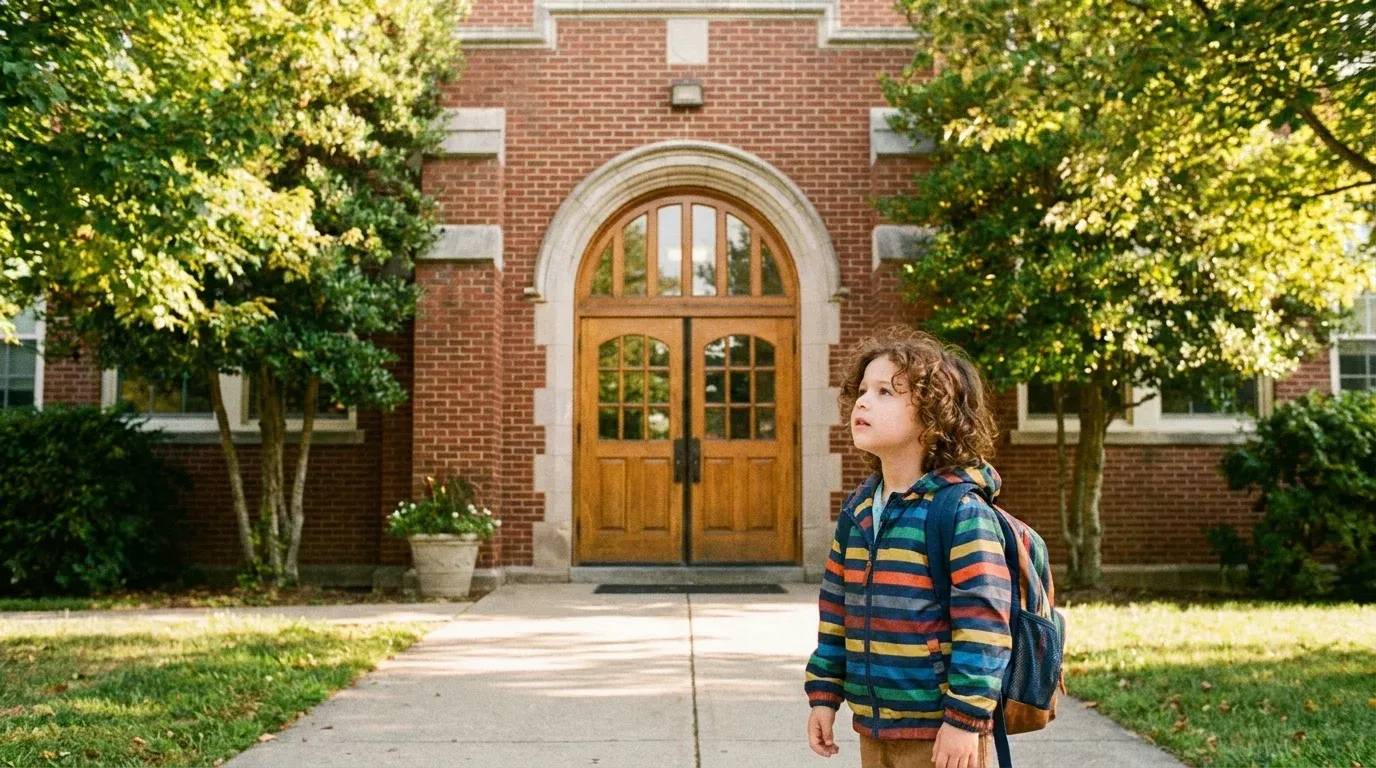
Why a New School Feels Scarier Than a New Grade
When a child moves up a grade, the school building is the same. The smells, the layout, the lunchroom sounds — all unchanged. They walk in carrying invisible confidence: I know this place. A new school strips that invisible confidence away entirely. Your child has to learn the building, learn new faces, read a different social map, and perform academically — all at the same time. For a young child whose brain is still developing the capacity to manage multiple stressors simultaneously, that's a heavy cognitive and emotional load.
What parents and educators generally observe is that the biggest factor in how long adjustment takes isn't personality or even shyness — it's how unfamiliar the new environment feels. The more "known" a child can make their new school before they walk through the door, the faster they tend to settle. This is why the weeks before school starts matter more than most parents realize. And it's especially worth bearing in mind if your child tends to be more cautious by nature — for strategies that respect a quieter child's pace, the guide on how to help a shy child build confidence has a lot of useful overlap with school transitions.
There's also a second layer that often goes unspoken: the social fear. Academic adjustment is hard, but kids usually catch up with schoolwork quickly. The fear of "Will anyone want to eat lunch with me?" lingers much longer. Acknowledging this fear out loud — without minimizing it — is one of the most powerful things a parent can do early in the transition. For concrete scripts and strategies to help your child build those first connections, see our guide on helping your child make friends at a new school.
Routines That Build Familiarity Before Day One
Familiarity isn't only built at school — it's built at home too, through the rhythms that signal safety. A consistent daily routine in the two weeks before school starts does something measurable in a child's nervous system: it reduces the number of unknowns in any given day, which frees up emotional bandwidth for handling the big unknown (the new school). If every morning starts the same way — same breakfast, same getting-dressed order, same playlist in the car — the child arrives already partially regulated.
Beyond home routines, make the school building itself familiar before school starts. Here's a practical checklist to work through in the weeks before the first day:
- Visit the school campus at least twice before day one — walk the route from the drop-off point to the classroom if possible
- Find out your child's teacher's name and use it casually in the weeks before: "I wonder what Ms. Rivera's classroom looks like"
- Map the basics together: Where is the bathroom? Where do they line up after recess? Where does lunch happen?
- Meet one classmate before school starts, even briefly — a known face on day one changes everything
- Let your child pack their own bag with familiar comfort items (a photo from home tucked inside, their favourite pencil case)
- Practice the morning routine at full speed at least three times before the real day arrives
- Talk about drop-off in concrete terms: "I'll give you a hug at the blue door, and I'll be back at the blue door at 3 o'clock"
That last point deserves extra emphasis. Young children experience time differently from adults — "the end of the school day" is an abstract concept, but "the blue door at 3 o'clock" is concrete and manageable. The more specific your goodbye ritual and pickup plan, the safer the separation feels. If you've been through the daycare transition, you'll recognize this principle — it's the same predictability-first approach that works so well in preparing a toddler for their first day of daycare.
Rehearsing Success Through Story
Here's the step most parents skip — and it might be the most effective one. Children process new experiences through narrative. Before they've lived something, they mentally rehearse it through play and story. You can use this tendency deliberately. In the weeks before school starts, tell your child a story — regularly, at bedtime — in which they are the main character, and they navigate the new school confidently. Not a story where everything is perfect and easy, but one where they feel nervous, try anyway, and discover they can do it.
This isn't wishful thinking — it's a form of mental rehearsal that coaches, therapists, and educators use with adults. When your child hears a story where a character who looks and acts just like them walks into a new school and figures out where to sit at lunch, they're building a mental model of succeeding in that situation. The story creates a familiar map. When the real day arrives, some part of their brain recognizes: I've been here before.

At Epic Little Hero, we create illustrated storybooks where your child's real face appears in every scene — not just their name on the cover, but their actual features in every illustration. A story where your child walks confidently into a school, makes a new friend, and discovers something wonderful about their new place — starring them — hits differently than a generic book about a cartoon character. You can create your child's book with a theme that matches their world. If you're not sure which story world would suit your child best, the guide on how to choose a personalized book theme will help you match their personality to the right adventure.
Story rehearsal also gives you a low-pressure way to open conversations. After reading, you can ask: "What do you think our hero was feeling when they walked in?" "What would you do if that happened to you?" These questions surface fears your child might not raise directly — and let you address them gently, inside the safety of a story.
How Long Does It Take a Child to Adjust to a New School?
This is the question every parent types into Google at 11pm in August. The honest answer: most children need two to six weeks to feel genuinely comfortable in a new school, with the biggest shift usually coming at the end of week two. The first week is almost always the hardest — your child is running on adrenaline, vigilance, and sheer effort. Week two often brings a dip, because exhaustion sets in. By week three to four, if routines are consistent and the child is connecting with at least one peer, most kids report feeling like the school is "theirs."
Signs the adjustment is going well include: your child mentions a specific child's name (even casually), they stop asking to go back to the old school, and they start telling you small details about the day unprompted. Signs that extra support may be useful: persistent physical complaints (stomach aches, headaches) every morning past week three, significant regression in sleep or appetite, or a total shutdown when you ask about school. If you're seeing those signs consistently, it's worth a conversation with the teacher and potentially the school counselor — not as an overreaction, but as early support.
The transition to a new school shares emotional DNA with other big novelty experiences kids face — separation from familiar people, navigating unfamiliar social rules, having to be brave in public. If your child has faced something similar before, like preparing for summer camp and managing homesickness, you've already built some of the same muscles this transition requires. Remind your child — and yourself — of times they adapted before. That history is real evidence. The same gradual-exposure instinct also applies around Halloween — if your child tends to freeze up around the unexpected, the gentle prep plan for children who are scared of Halloween costumes uses the same step-by-step familiarity-building approach.
Frequently Asked Questions
How long does it take for a child to adjust to a new school?
Most children settle into a new school within two to six weeks. The first week tends to be the hardest, week two often brings a tiredness dip, and by weeks three to four — with consistent routines and at least one peer connection — most kids start to feel at home. Every child is different, and some may take a full semester, which is also normal.
What can I say to help my child feel better about changing schools?
Avoid "You'll be fine!" — it dismisses the fear. Instead, try: "It makes sense that you're nervous. New places are hard at first. And I know you can figure it out, because I've watched you do hard things before." Name the feeling, validate it, then offer evidence of their resilience — not a guarantee that everything will be easy.
Should I tell the teacher my child is anxious about switching schools?
Yes — briefly and specifically. Teachers appreciate a one-sentence heads-up: "She's excited but tends to need a few days to warm up to new environments." This helps the teacher give your child a low-key welcome rather than calling on them in front of the class on day one, which can feel overwhelming for a child who's already on high alert.
Is it normal for a child to cry about going to a new school even after the first week?
Yes, especially in weeks one and two. Morning tears that resolve quickly once the child is inside are generally a sign of a healthy separation response — hard but normal. If tears are accompanied by physical symptoms (stomach aches, headaches) that don't appear on weekends, or if your child is distressed throughout the day rather than just at drop-off, talk to the teacher to get a fuller picture of how your child is actually doing once you leave.
Can books really help a child prepare for a new school?
They can — especially stories where the child character faces a new situation and comes through it successfully. Children process experience through narrative, and hearing (or reading) a story that mirrors their own situation builds a mental model of coping. A book where your child's own face appears as the hero who navigates a new school takes that effect even further, because the identification is immediate and complete.
The weeks before a new school starts are some of the most important parenting weeks of the year — not because you need to eliminate your child's anxiety, but because you can shape how they hold it. Build the routines. Visit the building. Tell the story. And when your child walks through those doors on day one, they won't be walking in completely cold. They'll be walking in with a map — one they've already rehearsed. If you'd like to give them a story where they're already the confident hero, create your child's personalized book at Epic Little Hero — it takes just a few minutes, and it might be the most useful thing on their back-to-school list.