How to Help Your Child Make Friends at a New School
Worried your child won't find their people at their new school? Here are concrete friendship scripts, research-backed strategies, and one surprisingly powerful tool for building social confidence before day one.
You picture drop-off day, and the image that keeps surfacing isn't the new backpack or the fresh pencil case — it's your child standing at the edge of a playground, watching other kids play, not sure how to break in. That worry is one of the most common things parents carry into a new school year, and it makes complete sense. Social belonging isn't a nice-to-have for young children. It's foundational. A child who feels like they have at least one friend shows up differently — more willing to try, more willing to get things wrong, more willing to stay.
The good news is that knowing how to help your child make friends at a new school is less about personality and more about preparation. Friendships at this age are built on remarkably simple moves — and those moves can be practiced, scripted, and even rehearsed through story before the first bell ever rings.
Quick answer: To help your child make friends at a new school, teach them two or three specific conversation-starting phrases to practice at home, role-play what to do if someone says no, and read stories where they see a character — ideally themselves — confidently making a new friend. Child development research suggests that children who rehearse social scenarios, even in play, feel meaningfully more confident when the real moment arrives.
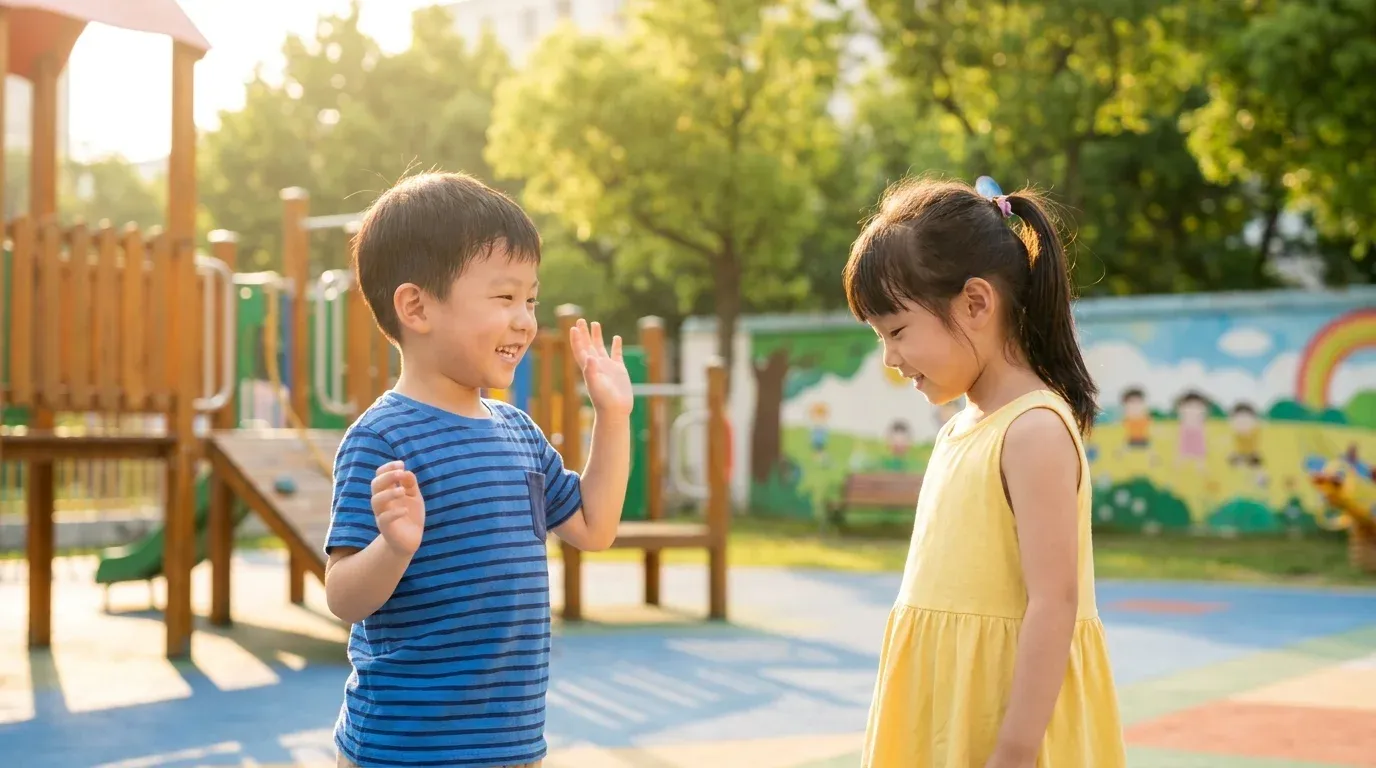
Why the First Friend at a New School Matters Most
Decades of developmental research point to the same finding: young children don't need a wide social circle to thrive — they need one good connection. A single stable friendship at school acts as a kind of social anchor. It lowers anxiety, increases engagement in learning, and makes children far more resilient when other social moments go badly (and some will). The first friend isn't just a playmate. They're proof that belonging here is possible.
This is why the opening days of a new class carry so much weight. Social patterns set early tend to stick. Children who connect quickly in the first week are more likely to feel settled within the month. Children who spend that first week on the outside find it harder to break into established dynamics as the weeks go on. That's not meant to alarm you — it's meant to make clear why a little intentional preparation before school starts is worth far more than reassurance offered after the fact.
If you're also helping your child navigate the wider transition — new routines, new teacher, new environment — the post on helping your child adjust to a new school when everything feels unfamiliar covers that fuller picture. But when it comes to friendships specifically, the strategy is concrete and learnable.
Friendship Scripts Kids Can Practice
One of the most practical things you can do is give your child actual words. Not a lecture about being friendly — actual phrases they can pull out when their brain goes blank. Young children (and honestly, many adults) freeze in new social situations not because they don't want to connect, but because they don't know what to say first. Removing that uncertainty makes an enormous difference.
Here are friendship scripts that work for both shy and outgoing kids, sorted by situation:
- Starting a conversation: "What's your name? Mine's [name]." — Simple, reciprocal, and invites a response naturally.
- Joining a game already in progress: "That looks really fun. Can I play?" — Acknowledges their activity before asking in, which feels respectful rather than pushy.
- Finding common ground: "Do you like [dinosaurs / Minecraft / drawing]? Me too!" — Shared interest is the fastest bridge between strangers.
- Recovering from a "no": "That's okay. Maybe next time!" — Teaches resilience without shame. Practice this one especially.
- Extending the connection: "Want to sit together at lunch?" — Moving from a short exchange to shared time is the step that turns an acquaintance into a friend.
- For shyer kids who need a lower-stakes entry: "I like your [backpack / shoes / drawing]." — A compliment requires almost no bravery and often sparks a whole conversation.
Practice these at home in low-pressure moments — at dinner, in the car, during bath time. Don't frame it as "practice for school." Just say, "Let's do a silly game where I'm a new kid and you have to make me feel welcome." Outgoing children will ham it up. Shy children will often engage more freely when it's framed as play. Either way, the words get into their mouths before they need them. If you're also working on your child's wider confidence, the guide on helping a shy child build confidence without pushing too hard has complementary strategies that pair well with these scripts.
Rehearsing Connection Through Story
There's something uniquely powerful about seeing yourself — your actual face, your name, your personality — make a friend in a story. Not a generic character. You. Child psychologists call this narrative rehearsal: when a child experiences a social scenario through a story first, their brain processes it almost like a real memory. The confidence from that story-moment carries forward into real situations.
This is the idea behind Epic Little Hero' personalized stories. A parent uploads a few photos of their child, and the AI generates a fully illustrated book where their child's real face appears on every page — walking into a new classroom, finding a friendly face across the room, saying hello, and discovering a new friend. It's not just entertaining. It's a social script delivered in the most engaging format young children have: a story starring them.
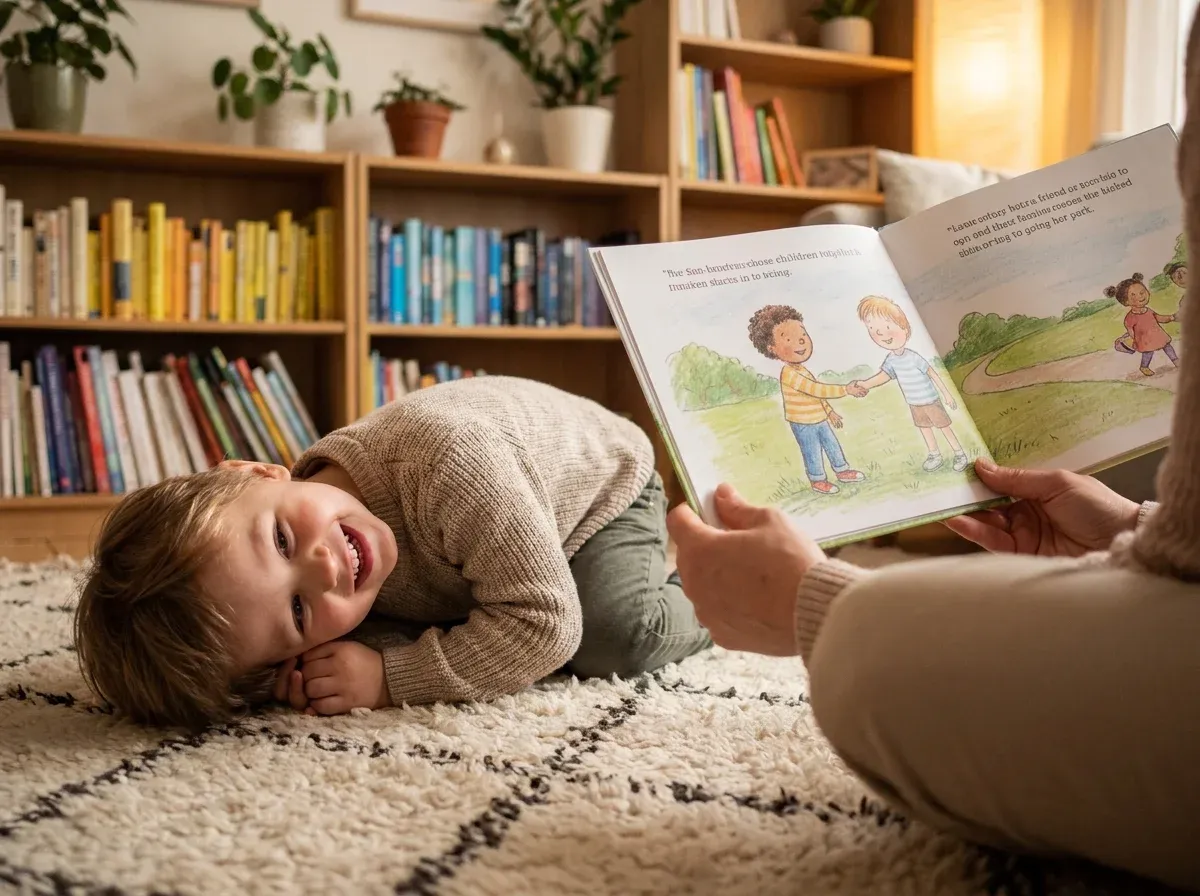
Reading a story like this together a few nights before school starts gives you something to point back to on drop-off morning: "Remember what you did in your book when you met that new friend? You can do the exact same thing today." For more on why this kind of story works at a neurological level, the post on stories that help kids be brave through narrative rehearsal goes deeper into the research. And if you want to understand why your child being the hero of their own story hits so differently than a traditional book, why kids light up when they're the main character explains the psychology beautifully.
An Epic Little Hero personalized story arrives as a digital PDF instantly and can be printed at home or at any print shop — so you're not waiting on shipping when back-to-school week is already here.
Frequently Asked Questions
What should I do if my child isn't making friends at school?
First, resist the urge to intervene immediately — some children take longer to warm up, and that's normal. Give it two to three weeks before drawing conclusions. In the meantime, create low-pressure opportunities outside school: a playdate with one classmate (not a group), an after-school activity based on your child's interests, or a simple "who seems nice?" conversation on the drive home. If after a month your child still feels consistently excluded or distressed, it's worth a gentle conversation with their teacher. Teachers see the classroom dynamics that parents can't.
What is the 3-3-3 rule for children and friendships?
The 3-3-3 rule is a simple social framework sometimes used by child therapists: make eye contact for 3 seconds, say 3 words ("Hi, I'm [name]"), and smile for 3 seconds. It's not a rigid script — it's a way of giving anxious children a concrete, memorable structure when the idea of "just go talk to someone" feels overwhelming. For young children who freeze in new social situations, having even a tiny action-plan like this can break the paralysis.
What is the 11-3-6 rule of friendship?
The 11-3-6 framework is a rough social circle model — roughly 11 people in an outer network, 3 to 5 close friends, and 1 to 2 truly intimate bonds. Research also suggests that meaningful friendships typically require significant shared time to form. For young children, both ideas serve the same reminder: we're not trying to make them popular. We're trying to help them build one or two genuine connections — which is all anyone really needs.
How do I help a shy child make friends at school without forcing them?
The key is to lower the entry cost of connection. A shy child who's expected to walk up to a group and introduce themselves faces a massive social hurdle. Instead: teach compliment-based openers ("I like your drawing"), identify one shared activity (the book corner, the building blocks table) where parallel play can organically become interaction, and celebrate small wins. "You smiled at someone today" is a genuine step forward. Never push — the goal is expanding their comfort zone by a centimeter at a time, not throwing them into the deep end.
Can books really help a child's social confidence?
Yes — and there's solid research behind it. Stories expose children to social scenarios in a safe, low-stakes environment. They see characters face the same fears they have, try something, and succeed (or recover from not succeeding). When the character in that story looks like them — same face, same name — the identification is even stronger. It's not magic. It's how human brains process experience: through narrative.
If the first day of a new class is coming up and you want to give your child something more than reassurance, a personalized story where they walk in, say hello, and walk out with a new friend might be the most useful thing you can put in their hands this week. Create your child's personalized friendship story — upload a photo, choose a theme, and have it ready in minutes. Because the confidence that comes from seeing yourself succeed, even just in a book, is the kind that follows a child right through the classroom door.